

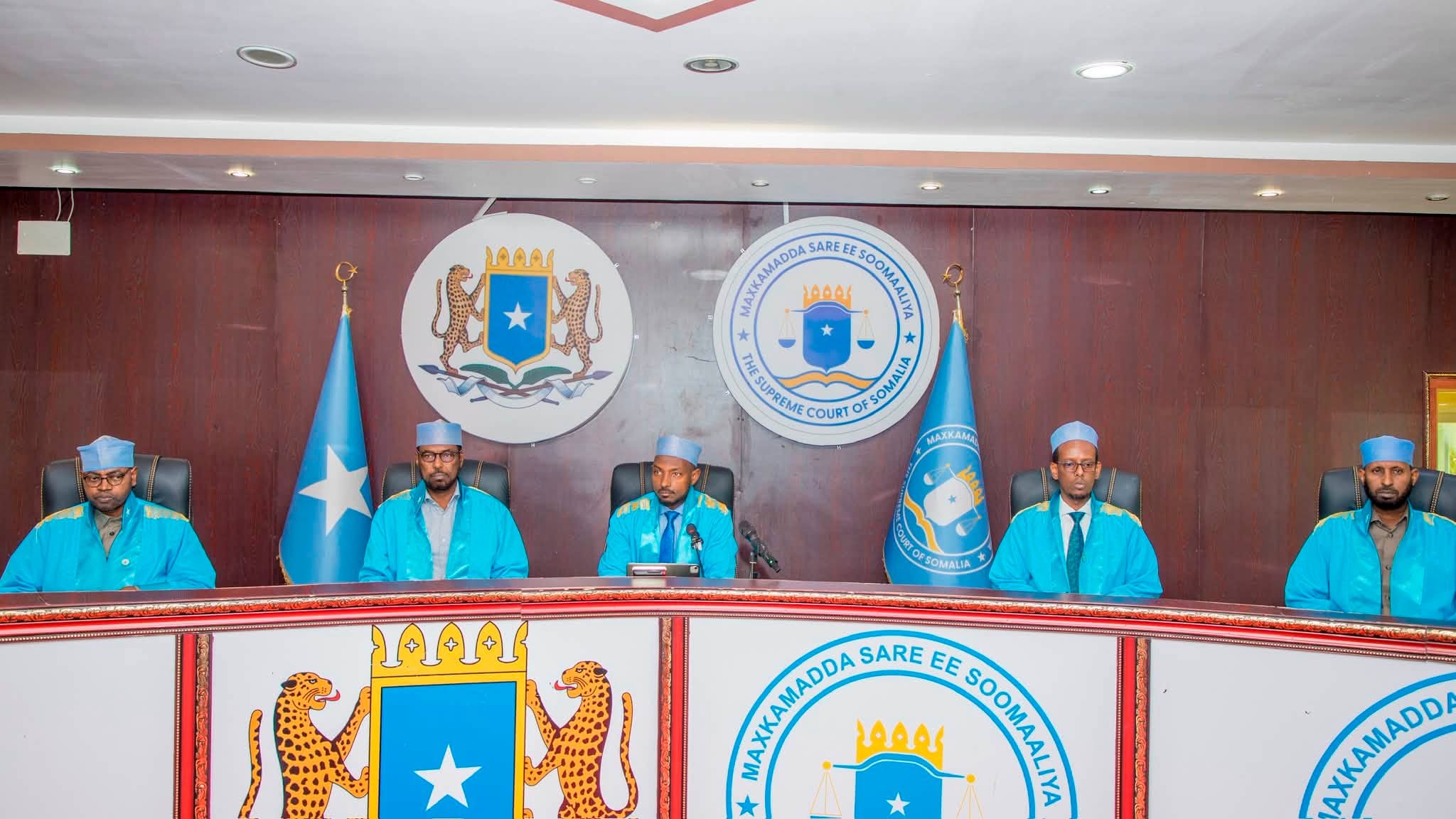
MOGADISHU, Somalia — Somalia’s Supreme Court has ordered a rerun of the recent Galmudug election after complaints over alleged irregularities in the electoral process, throwing the outcome of one of the country’s most closely watched local democratic exercises back into question.
The ruling concerns the July 30 election, which was conducted under a one-person, one-vote system across 11 towns and cities in Galmudug. Sixteen political parties took part, with authorities reporting that 197,971 voters cast ballots.
The Justice and Solidarity Party (JSP) emerged as the largest winner, securing 115 local council seats and 63 seats in the regional parliament.
The Supreme Court’s decision means the results will not stand as the final outcome, with voters expected to return to the polls in a process aimed at addressing the concerns raised over the conduct of the election.
A test for Somalia’s electoral transition
The Galmudug vote was significant because Somalia has been seeking to move away from an indirect political system dominated by clan-based selection toward broader direct participation by voters.
The one-person, one-vote model has been presented by the federal government as an important step toward building a more representative political system and strengthening the legitimacy of elected institutions.
The Supreme Court’s intervention, however, highlights the challenges involved in implementing that system.
The allegations of irregularities have placed renewed attention on electoral oversight, voter registration, ballot administration and the mechanisms available for resolving disputes.
The rerun could also become a test of whether Somalia’s emerging electoral institutions can resolve contested results through legal channels rather than political confrontation.
JSP faces uncertainty
The ruling creates uncertainty for the Justice and Solidarity Party, which recorded the strongest performance in the July election.
Its 115 local council seats and 63 regional parliamentary seats gave it a dominant position in the initial results. A rerun could alter that balance, depending on where voting is repeated and how the process is conducted.
For competing parties, the court decision provides an opportunity to challenge what they regarded as shortcomings in the original election.
The authorities now face the task of organizing a new vote while maintaining public confidence and ensuring that political parties accept the process and its outcome.
The Galmudug election has therefore become more than a regional contest. It is emerging as a test of Somalia’s broader experiment with direct elections and the country’s ability to build electoral institutions capable of handling disputes transparently and peacefully.


