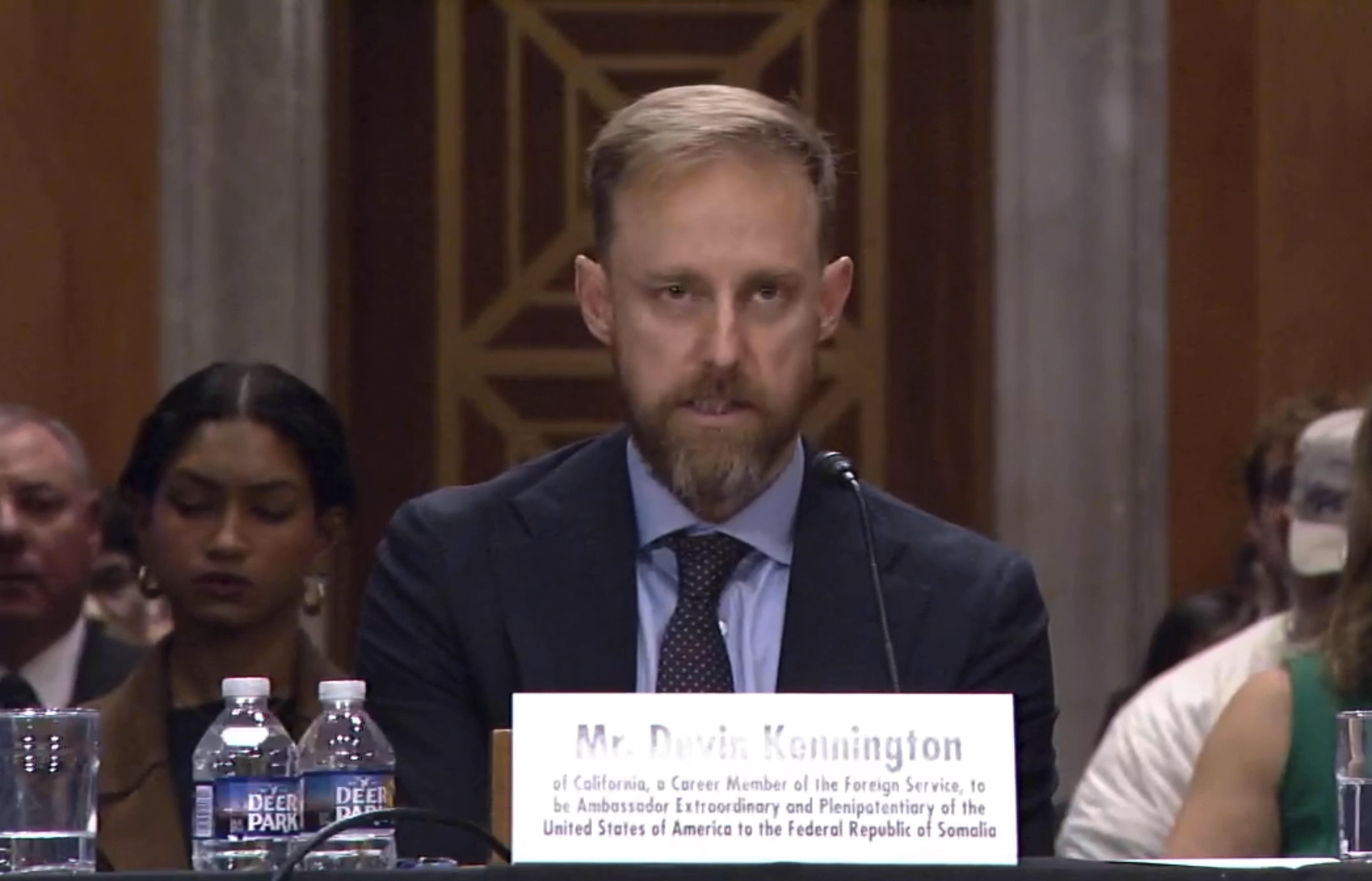
WASHINGTON — U.S. ambassador-nominee Devin Kennington has outlined a potential recalibration of Washington’s engagement with Somalia, calling for greater Somali responsibility for security, governance and development while questioning the effectiveness of decades of American financial assistance.
Speaking before the Senate Foreign Relations Committee on November 10, Kennington said the Trump administration intended to move away from aid-driven relationships towards partnerships built around trade, investment and mutual economic benefits.
His remarks offered an indication of how Washington’s diplomatic approach to Somalia could evolve if his nomination is confirmed, potentially placing greater pressure on Somali authorities to assume responsibility for national priorities while reducing dependence on international assistance.
Washington Questions the Effectiveness of Long-Term Assistance
During his testimony, Kennington argued that decades of substantial American assistance had not delivered sufficient progress in Somalia, which he described as remaining heavily dependent on international support while continuing to face serious security and governance challenges.
He cautioned against maintaining open-ended U.S. funding arrangements, arguing that continued assistance without greater local responsibility risked perpetuating dependency rather than addressing underlying institutional weaknesses.
If confirmed, he said he would pursue efforts to transfer greater responsibility for assistance programmes to other international partners and stakeholders with stronger interests in Somalia.
The approach reflects a broader emphasis on burden-sharing and economic engagement, with Washington seeking partnerships that deliver more tangible benefits rather than relying primarily on traditional development assistance.
Counterterrorism Cooperation Remains a Priority
Despite his criticism of long-term aid arrangements, Kennington indicated that the United States would maintain close cooperation with Somalia’s Federal Government on security and counterterrorism.
He identified counterterrorism, law enforcement and immigration as important areas of continued bilateral engagement, while emphasizing the protection of American diplomatic personnel and citizens as a central responsibility.
His remarks acknowledged the difficult security environment in Mogadishu and the risks facing American personnel operating in Somalia. The position suggests that a possible reduction in development assistance would not necessarily mean an end to Washington’s strategic security engagement with Mogadishu.
Somalia’s Security and Political Challenges
Kennington’s comments come as Somalia continues to confront multiple challenges, including the fight against Al-Shabaab, institutional capacity constraints and disagreements over the country’s political and electoral arrangements.
The Federal Government continues to rely on international partners for military assistance, training, intelligence cooperation and support for broader security operations.
At the same time, Somalia is seeking to strengthen its own security institutions and gradually assume greater responsibility for national defence and stabilization.
A shift towards greater Somali ownership could therefore have significant implications for the financing of security institutions, development programmes and the country’s relationship with international partners.
What His Nomination Could Mean for Mogadishu
Kennington’s nomination was submitted to the U.S. Senate in September 2026. His appearance before the Foreign Relations Committee on November 10 marked a further step in the confirmation process, but he has not yet been confirmed as ambassador.
If approved, he would assume responsibility for implementing Washington’s diplomatic priorities in Mogadishu at a time when relations between the two governments remain closely tied to security cooperation and Somalia’s wider political and institutional development.
His testimony signals a potential shift in emphasis: greater expectations for Somali ownership, increased economic engagement and a reassessment of long-term assistance, alongside continued cooperation on counterterrorism and other American security interests.
For Somalia, the central question will be how to strengthen national institutions and reduce dependence on external assistance while preserving the international partnerships that remain important to its security and development.