
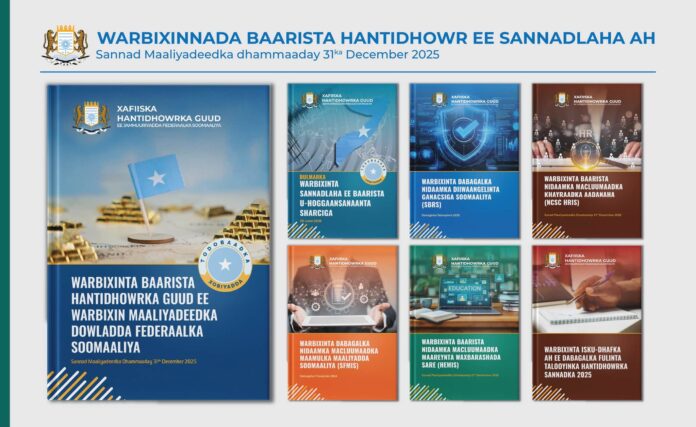
MOGADISHU — Somalia’s Office of the Auditor General has issued its 2025 financial audit, giving the federal government an “unqualified opinion” while identifying gaps in revenue management, procurement, information systems and compliance across several public institutions.
Auditor General Ahmed Issa Gutale presented the findings at a press conference in Mogadishu, saying the clean audit opinion meant the federal government’s financial statements fairly represented the country’s financial position in all material respects.
The audit covered 30 internationally funded projects, including 22 financed by the World Bank, seven by the African Development Bank and one by the International Fund for Agricultural Development.
Revenue systems remain fragmented
The audit found progress in integrating government revenue systems but said seven key systems were still not connected to Somalia’s Financial Management Information System.
The systems include business registration, tax administration, road-use taxation, rental income taxation, electronic entry permits, non-tax revenue collection and federal government revenue collection.
The Auditor General said the systems are managed by different government institutions, including the Ministry of Commerce and Industry and the Immigration and Citizenship Agency, creating challenges for comprehensive financial oversight and revenue reporting.
The findings highlight a broader challenge facing Somalia as the government seeks to strengthen domestic revenue collection and reduce reliance on external financing.
Government earns $42.2 million from airport and port contracts
The audit also detailed government revenue-sharing arrangements involving the companies operating Mogadishu’s port and Aden Adde International Airport.
Under the arrangements, the federal government receives a share of revenues generated by Al Bayrak, which operates Mogadishu Port, and Favori, which manages Aden Adde airport.
The government received a combined $42.24 million from the two operators during the year under review, according to the audit.
Of that amount, approximately $38.08 million came from Al Bayrak’s operations at Mogadishu Port, while about $4.15 million came from Favori’s management of Aden Adde International Airport.
The figures place major infrastructure concessions among the significant sources of government revenue and underline the importance of transparent revenue-sharing arrangements and effective oversight.
22 institutions reviewed for legal compliance
The Auditor General’s Office also conducted compliance audits of 22 federal government institutions whose combined budgets totaled about $822 million, representing 60.1% of the federal government’s overall budget of approximately $1.36 billion.
The review examined procurement, human-resource management, asset management and internal controls. Auditors identified 66 instances of non-compliance or other weaknesses.
Among the findings, the Ministry of Foreign Affairs was cited for sending 14 diplomats abroad without fully meeting required procedures. The audit also found that 14 employees had not completed required diplomatic training before beginning their assignments.
The findings point to continuing weaknesses in administrative controls even as Somalia works to professionalize its public institutions and strengthen oversight of government spending.
Concerns over government data and private companies
The audit raised another concern over the management of government information systems.
According to the findings, private companies are involved in operating, developing and managing some government information systems without formal agreements with the relevant public institutions.
The Auditor General warned that such arrangements could expose the government to risks involving ownership and protection of public data, cybersecurity, continuity of essential services, dependence on private contractors and accountability for public expenditure.
The office also identified shortcomings in areas including vehicle registration, revenue-sharing agreements, registration of externally funded assets, management of mosques and endowments, pharmaceutical inspections and the preservation of criminal records.
Separate audits were conducted on tax exemptions, property taxes and point-of-sale systems, as well as the National Disaster Management Agency, or SoDMA, and Somalia’s embassies in Kenya, Türkiye and Djibouti.
The report comes as Somalia continues efforts to strengthen public financial management and domestic revenue collection while improving transparency and accountability across federal institutions.
The Auditor General’s clean opinion represents a positive assessment of the government’s consolidated financial reporting, but the detailed findings show that significant institutional and systems-level weaknesses remain to be addressed.