
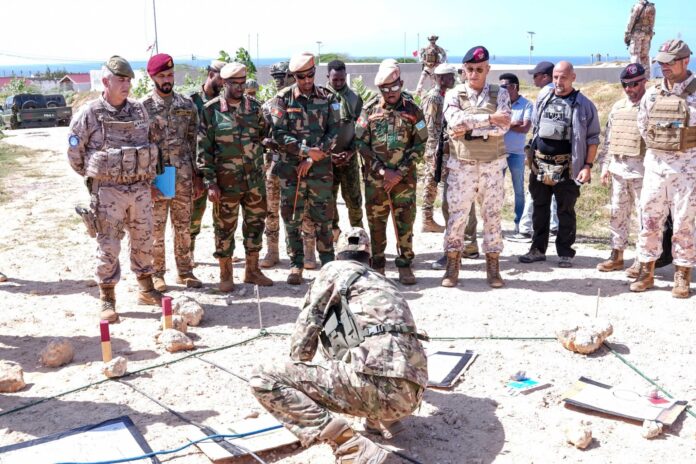
MOGADISHU, Somalia — Somalia’s military leadership has completed an officer-training programme aimed at strengthening the professional skills and leadership capabilities of personnel in the Somali National Army, as the government continues efforts to build a more capable national security force.
Chief of Defence Force Brig. Gen. Ibrahim Mohamed Mohamud presided over the closing ceremony alongside the commander of the Army Ground Forces, Gen. Sahal Abdullahi Omar, and Gen. Ahmed Issa Ahmed, head of the Training and Doctrine Command.
The ceremony was also attended by Brig. Gen. Elio Manes, the force commander of the European Union Training Mission in Somalia, known as EUTM-Somalia. The presence of the EU mission underscored the role of international military partnerships in Somalia’s effort to develop professional national forces.
The officers completed their training at the Gen. Dhagabadan Training School in Mogadishu, where the programme focused on strengthening military knowledge, professional competence and leadership.
The course is part of a broader effort to develop Somali officers who can take on greater responsibility within the national armed forces as Somalia seeks to strengthen its own security institutions.
Building a professional military
For Somalia, the development of trained officers has become increasingly important as the government seeks to build security forces capable of assuming a larger share of responsibility for national security.
EUTM-Somalia has worked alongside Somali authorities for more than a decade, providing training, mentoring and strategic advice aimed at developing a professional military accountable to the Somali government. Its current mandate also includes support for the development of Somalia’s wider security forces.
The mission has expanded its training output under its current mandate, working with Somali and international partners to increase the number of personnel receiving specialized military instruction.
The training at Dhagabadan comes as Somalia continues to confront the security threat posed by Al-Shabaab, while simultaneously trying to strengthen the institutions responsible for defending the country.
Military officials have increasingly emphasized leadership, doctrine and professional standards alongside battlefield capabilities — a shift intended to make the Somali armed forces more sustainable as international security support evolves.
The completion of the latest officer programme therefore represents more than the end of a training course. It is part of Somalia’s longer-term attempt to develop a military whose officers can command, train and manage forces with greater independence.
For the government in Mogadishu, building that capacity remains central to its broader effort to place national security increasingly in the hands of Somali institutions.