
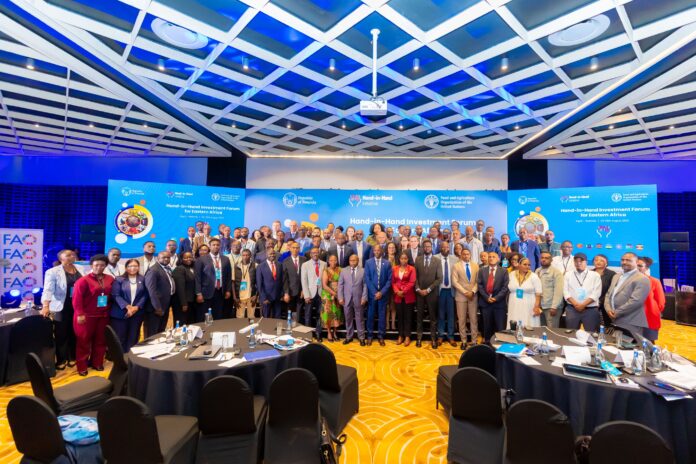
KIGALI, Rwanda — Somalia is seeking to attract international investment into its agriculture and livestock sectors, presenting $183 million in investment opportunities at the East Africa Hand in Hand Investment Forum in Kigali.
The opportunities, presented by Somalia’s Ministry of Agriculture and Irrigation and Ministry of Livestock, Forestry and Range, cover value chains including sesame, maize, dairy and animal fodder.
Somali officials said the proposed investments could benefit more than 3.5 million farmers and pastoralists, while helping modernize the country’s agrifood systems and create stronger links between producers, markets and investors.
The government’s pitch comes as Somalia seeks to reduce dependence on humanitarian assistance and build more productive agricultural and livestock sectors capable of generating income, employment and food security.
Agriculture at the center of investment push
Agriculture and livestock remain central to Somalia’s economy and livelihoods, particularly in rural communities where millions of people depend on farming and pastoralism.
The investment opportunities presented in Kigali are designed to target gaps across the agricultural value chain, from production and processing to markets and distribution.
Sesame, maize, dairy and fodder were highlighted as areas with potential for commercial investment and expansion.
The government says developing these sectors could increase productivity, strengthen food supplies and create new opportunities for farmers and pastoralists.
The Hand-in-Hand Initiative, led by the Food and Agriculture Organization of the United Nations, aims to accelerate agricultural transformation and rural development by connecting countries with investment and development partners.
Somalia’s participation in the Kigali forum reflects its effort to position agriculture not only as a source of livelihoods and food security but also as an investment opportunity.
From aid to investment
The push for private investment comes as Somalia faces persistent humanitarian needs, climate shocks and limited employment opportunities.
Droughts and floods have repeatedly disrupted agricultural production and livestock, while insecurity and inadequate infrastructure have constrained access to markets.
Officials argue that investment in productive sectors can help address some of those structural weaknesses by improving agricultural productivity and creating more resilient livelihoods.
The $183 million pipeline presented in Kigali therefore represents an attempt to move the conversation beyond emergency assistance toward longer-term economic development.
For Somalia, attracting capital into agriculture could also help expand domestic production and reduce reliance on imported food.
The government is increasingly presenting the country as an emerging investment market, with agriculture and livestock among the sectors it sees as capable of generating broad-based economic benefits.
At the Kigali forum, the message was direct: Somalia wants investors to look beyond its humanitarian challenges and toward the commercial potential of its agrifood economy.