By Abdirahman Jeylani Mohamed
MOGADISHU, Somalia – Somalia President Hassan Sheikh Mohamud’s proposed National Reconciliation Conference, grandly themed “Countering Terrorism and Building a Modern Democratic State,” was envisioned as a historic opportunity to steer Somalia toward stability.
According to several observers, yet, as preparations unfold, the gathering risks becoming ensnared in the very political divisions it seeks to resolve.
The success or failure of this initiative will hinge on one critical question: Can Somalia’s fractured leadership move beyond entrenched rivalries and prioritize national unity?
The “Elephants” in the Room
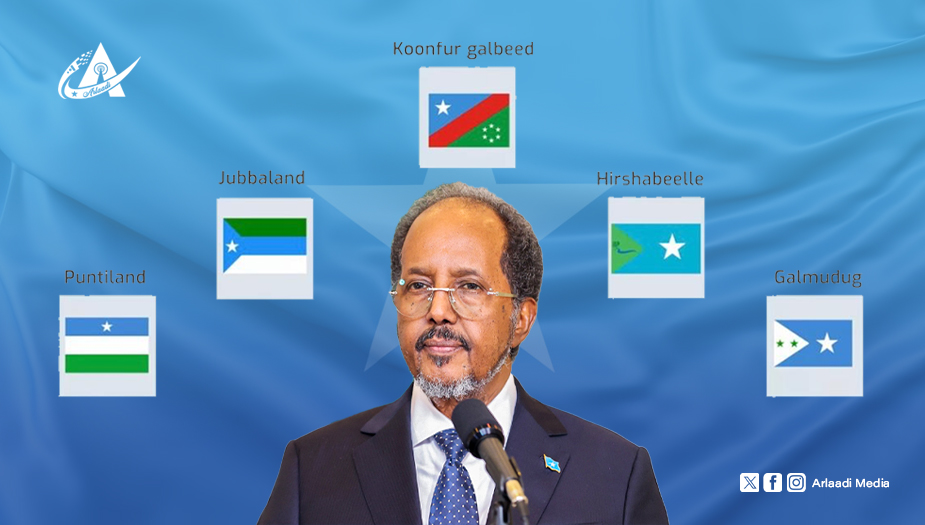
No issue looms larger than the uncertain participation of Puntland and Jubaland, two pivotal federal states whose absence would cripple the conference’s legitimacy.
Puntland officials have so far not formally disclosed its position on the dialogue but showcased signs of opposition to the conference.
The case of Jubaland’s President Ahmed Madobe – despite he endorsed the conference – epitomizes the challenge. His unresolved political status —Mogadishu still rejects his re-election—and the bitter legacy of past clashes, including the violent confrontation in Ras Kamboni, cast a long shadow over the proceedings.
International mediators have scrambled to broker a compromise, floating proposals that include security assurances, the lifting of travel restrictions, and a face-saving formula for Madobe’s inclusion.
But Mogadishu’s reluctance remains palpable. Reports suggest the federal government is resisting, wary of legitimizing a leader it views as a rival.
This impasse could prove costly. Without meaningful participation from these regions, the conference risks being dismissed as a partisan exercise rather than a genuine national dialogue.
The Opposition’s Gambit
Complicating matters further are the demands from some of the Somalia’s opposition factions, who insist that only “so-called heavyweight politicians be allowed to participate”.
This move, widely interpreted as an attempt to sideline potential challengers in the upcoming presidential elections, has injected another layer of discord into an already volatile process.
If enforced, such restrictions – who gets a seat at the table? – would exclude influential voices, undermining the inclusivity that such a dialogue demands.
The opposition’s stance reflects a deeper tension: the struggle between the government’s desire to control the narrative and the broader need for an open, representative forum.
HSM’s Delicate Balancing Act
President Hassan Sheikh’s approach appears to be a high-wire act. On one hand, he seeks to marginalize political adversaries by shaping the terms of engagement.
On the other, he must secure the participation of federal leaders—even if grudgingly—to avoid a total breakdown of the talks.
This dual strategy is fraught with risk. If Puntland and Jubaland opt out, or if opposition groups feel alienated, the conference could collapse into irrelevance, deepening the cynicism that plagues Somali politics.
The International Factor
External actors—including the UK, U.S., EU, and regional bodies like the African Union and IGAD—could play an indispensable yet double-edged role.
Their leverage may be necessary to break deadlocks, but overreach could render the conference a foreign-imposed solution rather than a homegrown consensus.
“The international community’s challenge is to support without overshadowing, to mediate without dictating,” one Observer noted.
A Defining Moment for Somalia
The stakes could not be higher. A successful, inclusive dialogue could lay the groundwork for a more cohesive and functional state, bolstering efforts against Al-Shabaab and strengthening Somalia’s democratic institutions.
A failure, however, would reinforce the cycles of mistrust and fragmentation that have hindered progress in the country for decades. As the conference approaches, Somali leaders face a stark choice:
Will they seize this moment to transcend narrow interests, or will they allow old grievances to condemn the country to further instability? The answer will shape Somalia’s trajectory for years to come. The world is watching—but more importantly, the Somali people are waiting.
The author is Abdirahman Jeylani Mohamed, current Director of Arlaadi Media, a foreign policy journalist and communications specialist, based in Mogadishu Somalia | @JaylaaniJr (X formally Twitter).