

By Abdirahman Jeylani Mohamed
MOGADISHU – Somalia stands once again at a familiar crossroads — the point where aspirations for democracy collide with deep-seated fears of instability. Recent political discourse has been dominated by an explosive phrase that, in a matter of hours, turned into both a rallying cry and a warning.
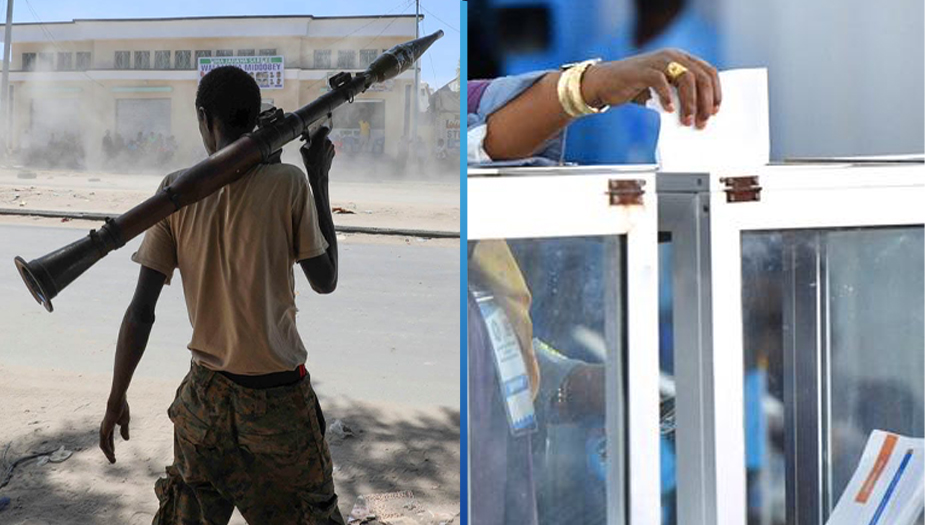
Opposition figures, skeptical of the “one person, one vote” election model championed by President Hassan Sheikh Mohamud’s administration, provocatively labeled the initiative “one person, one gun.”
This turn of phrase is not a mere linguistic flourish. It encapsulates the profound mistrust between Somalia’s ruling elite and opposition actors, and more importantly, it surfaces the darker undercurrents of Somalia’s fragile statehood: the shadow of clan-based politics, the legacy of civil war, and the ever-present specter of armed confrontation.
The Battle of Narratives
Government loyalists wasted no time in condemning the slogan. To them, calling the electoral push “one person, one gun” is reckless — a slogan that risks inflaming old wounds, legitimizing violence, and undermining fragile progress. “This is not political critique,” one government supporter argued privately, “this is an invitation to chaos.”
But the opposition disagrees. To them, the phrase is not only accurate but necessary. They contend that the electoral process, under the current administration, risks becoming exclusionary and coercive, driven more by force than by consensus. “What else should we call it,” asked one opposition figure, “when the ballot is guarded by the barrel of a gun?”
At its core, this clash is less about semantics and more about legitimacy. Both sides are seeking to frame the national conversation — one by projecting reform, the other by exposing fragility.
The 2026 Test
The timing of this rhetorical escalation could not be more critical. Somalia has yet to reach a formal consensus on what form the 2026 elections will take. President Hassan Sheikh, now entering the final stretch of his mandate, has staked much of his political legacy on delivering the first true “one person, one vote” election in decades.
In theory, this would mark a historic break from Somalia’s clan-based, indirect electoral system, which has long been criticized as undemocratic, opaque, and prone to corruption. But in practice, transforming that theory into reality is fraught with challenges.
Security remains a glaring obstacle. Al-Shabaab continues to mount deadly attacks, particularly in rural areas, raising doubts about whether nationwide polling can be conducted safely. At the same time, logistical hurdles — from voter registration to ballot distribution — loom large in a country where infrastructure is still underdeveloped and political institutions remain contested.
Perhaps most importantly, there is the issue of trust. Opposition groups argue that Hassan Sheikh’s administration has not created the inclusive political framework necessary to guarantee a fair process. Without that, they warn, a “one person, one vote” system risks becoming less an exercise in democracy and more an exercise in state-imposed dominance.
The Risk of Polarization
The phrase “one person, one gun” is troubling precisely because it speaks to the enduring fragility of Somalia’s political order. In a country where the memory of armed conflict remains vivid and where militia dynamics still shape power relations, invoking the language of weapons is not a metaphor — it is a reminder of lived reality.
Somalia’s political elite must tread carefully. The danger is not only that such rhetoric escalates into real violence, but also that it entrenches the perception among ordinary citizens that democracy is an elite contest played out through intimidation rather than genuine participation.
Already, fault lines are emerging. On one side are those who see Hassan Sheikh’s initiative as a long-overdue step toward a functional democracy. On the other side are those who suspect the entire process is engineered to consolidate power, sideline rivals, and extend control through state security forces.
A Moment for Statesmanship
What Somalia desperately needs now is statesmanship, not sloganeering. The opposition has every right — indeed, the responsibility — to hold the government accountable.
But in doing so, it must avoid language that risks legitimizing violence. Likewise, the government must recognize that dismissing opposition concerns outright will only deepen mistrust and drive more actors into cynicism or resistance.
If Somalia is to hold a credible election in 2026, both camps must engage in genuine dialogue about the mechanics of the vote — from security arrangements to voter registration to the role of international observers. Anything less, and the promise of “one person, one vote” could indeed spiral into the nightmare of “one person, one gun.”
The Road Ahead
Somalia’s democratic experiment is young, fragile, and deeply contested. But it is not doomed. The words being exchanged today — however sharp, however divisive — can still be channeled into a broader conversation about the kind of political system Somalia needs.
The real question is whether leaders are willing to rise above zero-sum politics and invest in building a system where the ballot, not the bullet, decides the nation’s future.
Until then, the battle of slogans will continue to echo. And with every repetition of “one person, one gun,” Somalia risks normalizing the very instability it seeks to overcome.
The author is Abdirahman Jeylani Mohamed, the current Director of Arlaadi Media Network, foreign policy journalist and a communications specialist.


