
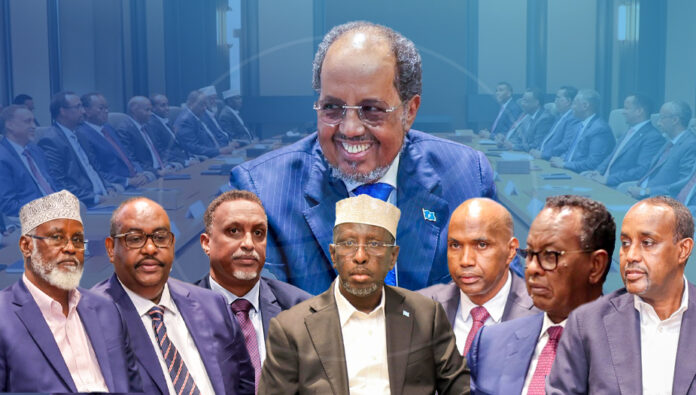
MOGADISHU, Somalia — Somalia’s fragile federal compact entered a critical new phase on Thursday as President Hassan Sheikh Mohamud convened the first round of talks with leading opposition figures and regional leaders, launching negotiations that could determine the shape of the country’s 2026 elections — and the stability of its constitutional order, Arlaadi Media Network reports.
The meeting, held at the presidential palace in Mogadishu, brought together President Hassan Sheikh and Prime Minister Hamza Abdi Barre with Puntland leader Said Abdullahi Deni and Jubaland’s Ahmed Mohamed Islam (Ahmed Madoobe).
Former President Sharif Sheikh Ahmed and former prime ministers Mohamed Hussein Roble, Hassan Ali Khaire, and Abdi Farah Shirdon were also in attendance.
The optics alone were significant. Both Deni and Madoobe had previously resisted holding the talks at Villa Somalia, citing security and political concerns. The opening session was delayed twice before last-minute understandings cleared the way for the gathering — a reminder of the mistrust that continues to define relations between Mogadishu and key federal member states.
Elections at the Core
According to three sources — two from opposing sides of the talks and one independent — Thursday’s session focused entirely on federal and state-level elections. No substantive agreement was reached.
“There was no breakthrough,” one participant told Arlaadi Media Network. “After a lengthy debate, the only understanding was to reconvene on Friday after prayers.”
The stakes are high. The mandates of Somalia’s federal parliament expire on April 15, 2026, followed by the presidency on May 15. Without a political settlement before those deadlines, Somalia risks entering a constitutional vacuum — a scenario that has previously triggered protracted crises and security instability.
President Hassan Sheikh is reportedly pushing to initiate local council elections by mid- or late April this year, followed by presidential elections in several federal member states.
The sequencing is politically consequential: three regional administrations — South West, Galmudug, and Hirshabelle — are led by presidents whose mandates have technically expired but who remain in office under political agreements.
Constitutional Fault Lines
A new national deal between Villa Somalia and opposition actors could reshape, or even undermine, those arrangements. It remains unclear whether opposition leaders will accept the president’s proposed roadmap.
Beyond the mechanics of elections lies a deeper dispute over Somalia’s provisional constitution. Opposition figures are advocating a return to the 2012 constitutional framework, arguing that recent amendments lack sufficient consensus.
The president’s camp, by contrast, insists on completing the constitutional review process — despite mounting resistance from political rivals and some regional administrations.
The constitutional debate is not merely legalistic. It touches on the balance of power between the federal center and member states, the model of elections (direct versus indirect), and the broader trajectory of Somalia’s state-building project.
A Cautious International Reception
Several diplomats based in Mogadishu, speaking briefly to Arlaadi Media Network, offered cautious praise for the launch of talks but stopped short of endorsing any side’s position. Their final assessments, they indicated, will depend on whether the negotiations produce a credible and inclusive electoral framework in the coming days.
International partners have long pressed Somali leaders to resolve disputes through dialogue rather than brinkmanship. But past experience suggests that consensus often emerges only under intense time pressure — sometimes at the eleventh hour.
Friday’s follow-up meeting is expected to clarify whether the talks will deepen into structured negotiations or stall amid familiar accusations of overreach and bad faith.
For Somalia, the moment is consequential. After years of incremental security gains and diplomatic normalization, the country’s political class once again faces a test: whether it can manage competition within institutional bounds — or slide toward another cycle of paralysis. With just over a year before federal mandates expire, time is short, and the margin for miscalculation is narrowing.