
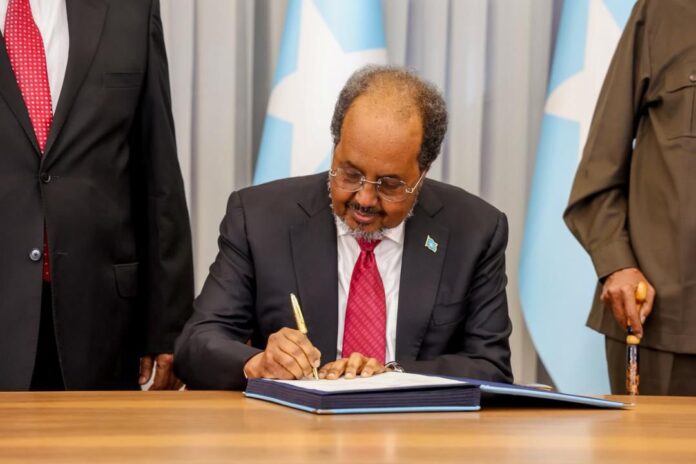
MOGADISHU – Somalia’s President Hassan Sheikh Mohamud signed constitutional amendments into law on Sunday, declaring the official end of Somalia’s long-standing provisional constitution, a move he said would strengthen state institutions and guide the country toward political stability.
The amendments, approved by both houses of the Federal Parliament, conclude a years-long process aimed at revising the provisional constitution adopted in 2012 as Somalia sought to rebuild its state institutions after decades of conflict.
“Today I signed the newly amended Constitution of the Federal Republic of Somalia, approved by both Houses of the Federal Parliament,” Mohamud said after the signing ceremony.
“This historic step ends the provisional era, strengthens state institutions, protects citizens’ rights, and advances Somalia’s democratic future,” he added, expressing hope that the new constitutional framework would help steer the country toward lasting political stability.
However, the move has drawn criticism from some political figures and analysts who say the amendments could centralize power and weaken Somalia’s federal system.
Former Somali president Mohamed Abdullahi Mohamed (Farmaajo) has criticized the decision.
“The step taken by the outgoing President, Hassan Sheikh Mohamud, in signing the constitution he drafted reinforces the risks surrounding the country’s statehood and the unity of our people,” Farmajo said in a statement.
“Without consensus and timely elections, our state-building processes will be in danger,” he added.
Regional researcher and analyst Rashid Abdi also said the changes risk undermining democratic governance.
“The disastrous amendments to Somalia’s provisional constitution, which extend HSM’s mandate by one year, render the post of prime minister superficial and neuter the federal system, put Somalia on a backward path to an authoritarian centralized state,” Abdi said.
Somalia adopted its provisional constitution in 2012 as part of efforts to establish a federal system and rebuild government institutions after the collapse of the central state in 1991.
The latest amendments come amid ongoing political tensions between the federal government and some regional administrations, as well as continued security challenges posed by the militant group Al-Shabaab.