MOGADISHU – The most effective forms of censorship are not always the most visible. Sometimes there are no arrests, no newsroom raids and no public bans. Instead, a video disappears, a livestream vanishes or an investigative report is removed from social media because someone—often an unknown third party—claims to own material they did not create.
Across Somalia’s increasingly polarized digital landscape, journalists, media organizations and, more recently, opposition politicians say this is becoming an increasingly familiar experience.
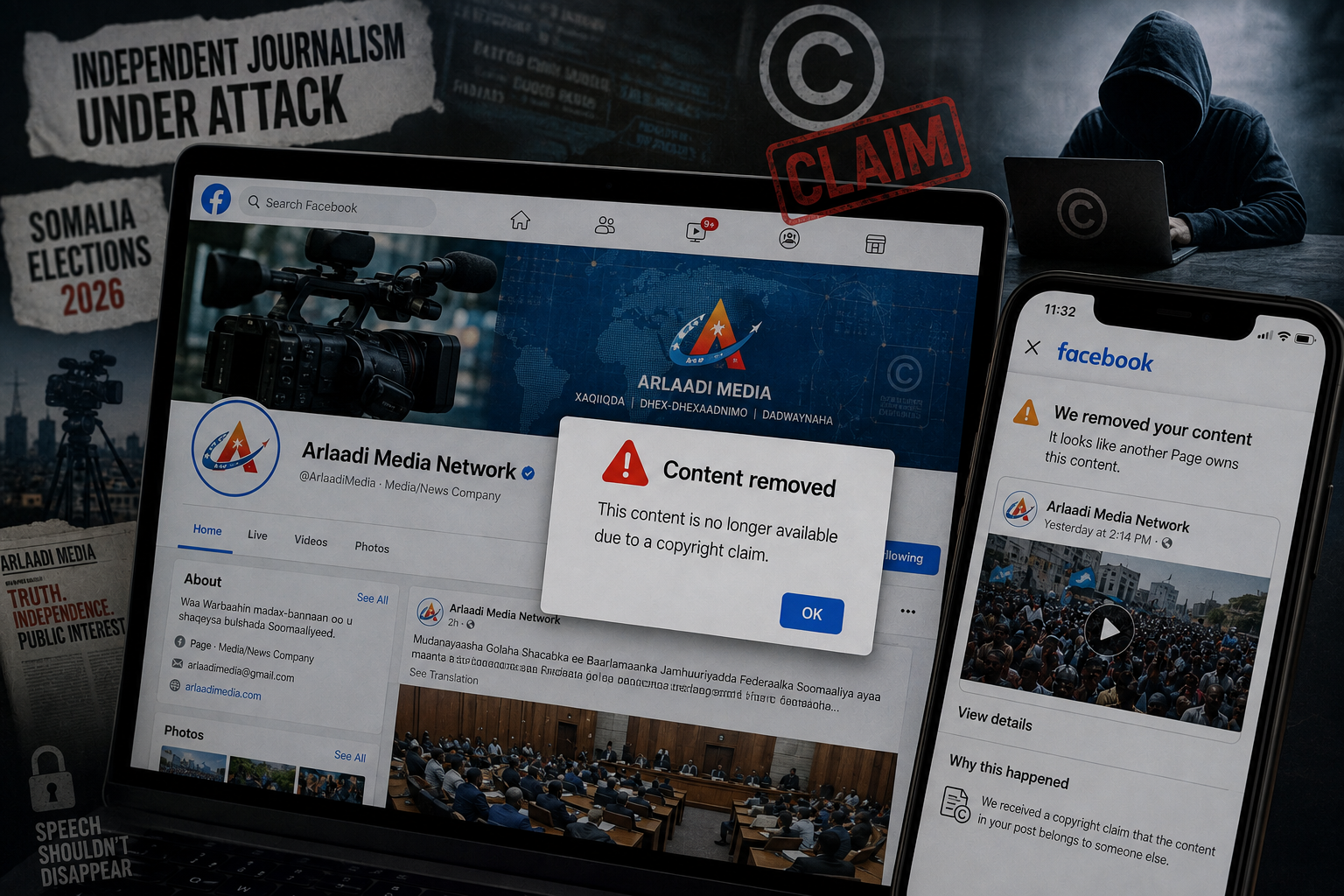
What began as isolated copyright disputes has evolved into what several Somali media organizations describe as a recurring pattern: original reporting is copied, republished by unrelated accounts and then used as the basis for copyright complaints against the journalists who produced it in the first place. Because platforms such as Facebook and Instagram rely heavily on automated copyright enforcement systems, disputed material is frequently removed before ownership can be fully assessed.
The result is that the original publisher—not the alleged infringer—must spend days or weeks navigating appeals while the content disappears during the period when public attention is at its highest.
The consequences are particularly significant in Somalia, where Facebook remains one of the country’s dominant sources of news and political information. For many independent outlets, social media is not merely a distribution channel but the primary means of reaching audiences inside and outside the country.
From Copyright Protection to Political Suppression?
Copyright systems were designed to protect creators from piracy. Increasingly, however, digital rights researchers and media advocates around the world have warned that those same mechanisms can be abused through fraudulent or bad-faith claims designed to silence legitimate speech.
Somalia appears to be experiencing that vulnerability firsthand.
Over recent months, multiple Somali news organizations have reported waves of copyright complaints targeting their Facebook content. Some outlets say videos covering politically sensitive events disappear within minutes of publication, despite being filmed, edited and produced entirely by their own journalists.
Among those reporting repeated restrictions is Arlaadi Media, which says original news reports have repeatedly been subjected to copyright claims from unfamiliar entities despite being its own intellectual property. According to the outlet, the disputed content has often included reporting on opposition activities and politically sensitive developments, significantly reducing its reach while appeals remain pending. More recently, Arlaadi Media said it was hit by what it described as a coordinated campaign of fraudulent copyright reports targeting its Facebook page.
Other Somali media organizations have publicly voiced similar concerns.
The Somali Media Women Association (SOMWA) has called for greater scrutiny of Meta’s copyright reporting system after reports that copyright complaints were being used against legitimate journalistic content. The organization warned that, if such mechanisms are being exploited, they could have serious implications for press freedom and public access to information. It urged Meta to investigate whether coordinated or fraudulent reporting campaigns are occurring.
A Shift Beyond Newsrooms
Perhaps the most striking development is that the alleged tactics are no longer confined to journalists.
In recent weeks, opposition political figures and regional administrations have also reported experiencing copyright-based removals affecting campaign speeches, public rallies and political messaging distributed on social media. The apparent expansion from independent media to political actors suggests that the issue extends beyond conventional copyright disputes and has become part of the broader contest over political communication in Somalia.
Whether each individual claim is legitimate can only be determined through case-by-case review. However, media organizations argue that the pattern itself deserves closer examination, particularly when original content repeatedly disappears during moments of heightened political importance.
The Problem With Automated Enforcement
Meta’s copyright enforcement system was built to respond quickly to complaints in order to protect intellectual property rights.
That speed, however, creates vulnerabilities.
Automated systems generally prioritize immediate removal over detailed investigation. Human review often occurs only after appeals are submitted, meaning even false claims can temporarily remove lawful content. By the time a dispute is resolved, the news cycle has usually moved on, public attention has shifted and the lost audience cannot easily be recovered.
For journalists covering elections, parliamentary debates, security developments or public protests, timing is often everything.
A report removed for several days may ultimately be restored, but its public impact has already been diminished.
A Growing Challenge for Press Freedom
Somalia has made important progress in expanding its digital media environment over the past decade. Independent online journalism has become an increasingly important source of accountability in a country where traditional media often face financial, political and security pressures.
Yet the emergence of alleged copyright-based takedowns presents a new challenge.
Unlike arrests or website blocking, copyright complaints leave few obvious signs of censorship. Content simply disappears, often with little public explanation, while affected organizations shoulder the burden of proving ownership of work they created themselves.
For media outlets already operating with limited legal and technical resources, repeated disputes consume time, reduce audience reach and undermine confidence in digital platforms as reliable spaces for independent journalism.
Whether these cases represent isolated abuses or evidence of coordinated campaigns remains a matter requiring careful investigation by technology companies and independent experts.
What is becoming increasingly difficult to dismiss, however, is that copyright enforcement—designed to safeguard creative work—can, if misused, become an effective instrument for restricting public debate without ever explicitly banning it.
For Somalia’s journalists, the concern is no longer simply about protecting intellectual property. It is about protecting the public’s ability to receive information at the moment it matters most.