
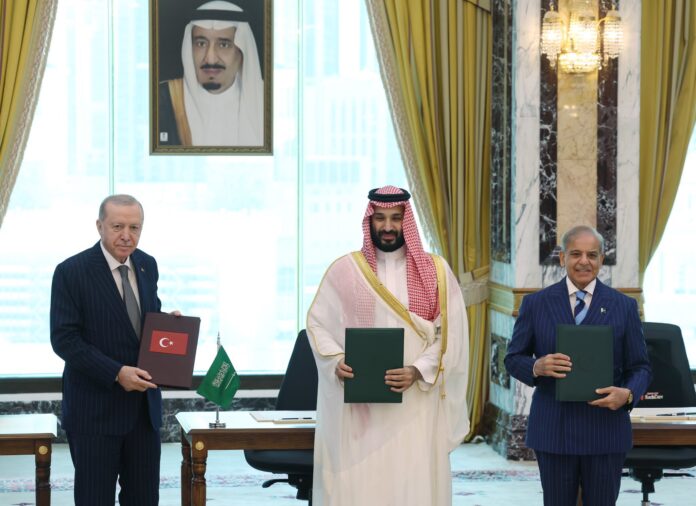
MOGADISHU — Somalia has welcomed a new defence agreement between Saudi Arabia, Türkiye and Pakistan, describing the pact as an important step towards strengthening collective security and cooperation at a time of heightened tensions across the region.
Somalia’s Ministry of Defence said on Friday that it congratulated the three countries on signing the Mecca Joint Defence Agreement, calling it a “historic step” towards developing defence cooperation and building a strategic partnership to address shared security challenges.
The ministry said the agreement could contribute to regional and international stability while reinforcing principles of cooperation, solidarity and shared responsibility.
The pact was signed in Mecca on Friday by Saudi Crown Prince Mohammed bin Salman, Turkish President Recep Tayyip Erdogan and Pakistani Prime Minister Shehbaz Sharif. It establishes a framework for closer defence cooperation and includes a mutual-defence commitment under which an attack against one signatory is to be treated as an attack against all three.
The agreement brings together three countries with significant military and strategic weight: Saudi Arabia, a major Gulf power; Türkiye, a NATO member with one of the region’s largest armed forces; and Pakistan, the only nuclear-armed Muslim-majority state.
A changing regional security landscape
The announcement comes amid a period of heightened security concerns in the Middle East and beyond. The three governments have increasingly expanded defence coordination, with Saudi Arabia and Pakistan already signing a bilateral Strategic Mutual Defense Agreement in September 2025. That agreement similarly stated that aggression against either country would be considered aggression against both.
Saudi Arabia and Türkiye have also sought to deepen their defence relationship. During Turkish President Recep Tayyip Erdogan’s visit to Riyadh in February, the two governments reaffirmed their commitment to expanding defence cooperation and activating existing agreements.
The new trilateral arrangement therefore builds on relationships that were already developing rather than creating defence cooperation from scratch.
Analysts have described the agreement as potentially significant for the regional balance of power, particularly as governments reassess their security arrangements amid continuing tensions involving Iran, Israel and conflicts across the Middle East.
Why Somalia is watching closely
For Somalia, the agreement carries particular significance because Mogadishu has been expanding defence and security relations with all three countries.
Somalia and Saudi Arabia have strengthened their military relationship, while Türkiye has become one of Mogadishu’s most important security partners. Pakistan has also emerged as a potential partner as Somalia seeks to expand training, professionalise its armed forces and build the capacity needed to assume greater responsibility for national security.
Somalia’s welcome for the Mecca agreement signals that Mogadishu views closer coordination among major Muslim-majority states as potentially supportive of wider regional stability.
It also comes as Somalia faces a difficult security transition. The African Union Support and Stabilization Mission in Somalia, or AUSSOM, is expected to move gradually towards transferring security responsibilities to Somali forces, while international partners continue debating how the mission should be financed and supported.
At a recent summit in Kampala, the leaders of AUSSOM troop-contributing countries called for an orderly and phased transition and urged international partners to address the mission’s financial shortfalls. They also stressed the need to strengthen Somali security institutions, intelligence capabilities and military capacity before foreign forces withdraw.
That transition has increased the importance for Mogadishu of developing a network of bilateral security partnerships alongside its cooperation with the African Union and United Nations.
Beyond Somalia
The Mecca agreement could also reshape the way Saudi Arabia approaches regional security.
Riyadh has traditionally relied heavily on its partnership with the United States while simultaneously developing defence relationships with other powers. Its expanding ties with Türkiye and Pakistan give the kingdom additional military and diplomatic options.
Pakistan brings decades of military cooperation with Saudi Arabia, while Türkiye offers a rapidly expanding defence industry and growing influence across the Middle East and wider Muslim world.
The agreement does not, however, automatically create a single military bloc with a common foreign policy. Much will depend on how the three governments translate the pact into military planning, intelligence cooperation, joint exercises and mechanisms for responding to a crisis.
For Somalia, the immediate significance is more practical.
Mogadishu is seeking stronger partnerships as it confronts Al-Shabaab, prepares for the eventual departure of international forces and attempts to build a national security system capable of operating with greater independence.
The Defence Ministry said the Mecca agreement should serve the interests of the peoples of the region and support efforts to establish peace and security.
Its endorsement underscores Somalia’s growing interest in a regional security architecture in which Arab, African and Asian partners play a greater role alongside the United States, European countries, the African Union and the United Nations.