
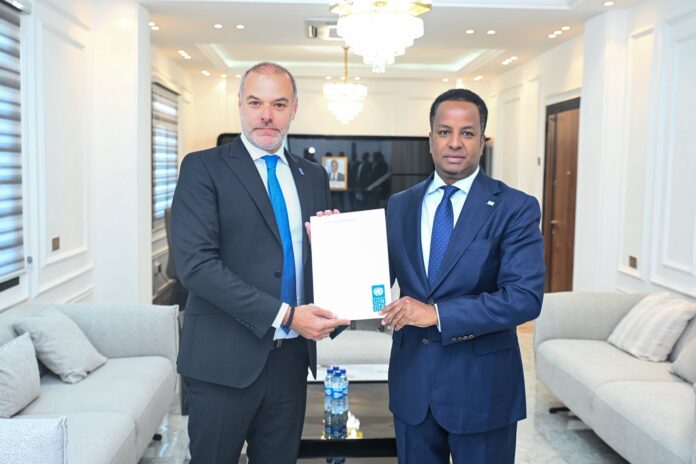
MOGADISHU, Somalia — Somalia and the United Nations Development Programme have moved to strengthen cooperation on national development priorities, with the arrival of a new UNDP resident representative and the signing of a new framework for joint work.
Somalia’s Foreign Minister, Abdisalam Abdi Ali Dhaay, received the credentials of Chris Politis, the newly appointed UNDP Resident Representative, in Mogadishu on Tuesday, formally marking the beginning of Politis’ engagement with Somali authorities.
The diplomatic exchange was followed by a meeting between Politis and Hamza Adan Haadoow, permanent secretary of Somalia’s Ministry of Foreign Affairs. The two sides signed a cooperation memorandum intended to advance joint efforts around Somalia’s development priorities and strengthen support for institutional and economic progress.
The agreement comes as Somalia seeks to consolidate gains in state-building while facing persistent challenges involving economic development, governance, security and the delivery of public services.
UNDP has been involved in several areas of Somalia’s institutional development, including support for political processes, constitutional reform and capacity-building for federal and state institutions. Its current work includes efforts to support an inclusive, Somali-led constitutional process and strengthen the capacity of government institutions and civil society.
The development partnership also comes at a moment when Somalia is seeking to broaden domestic institutions’ ability to manage long-term development programmes rather than relying solely on external assistance.
The new cooperation framework is expected to provide a basis for closer coordination between the Somali government and UNDP as the country works to strengthen public institutions, improve economic opportunities and advance broader development goals.
For UNDP, the appointment of a new resident representative provides an opportunity to deepen engagement with Somali authorities at a time when the country is attempting to move from emergency-focused international support toward longer-term institution building.
The latest agreement does not represent a new direction so much as a continuation of a longstanding partnership, but officials in Mogadishu are presenting the renewed cooperation as part of a broader effort to align international assistance more closely with Somalia’s own national priorities.
The challenge will be translating that partnership into stronger institutions and measurable improvements in the lives of Somalis, particularly as the government faces competing demands for resources and continues efforts to build a more self-reliant state.