
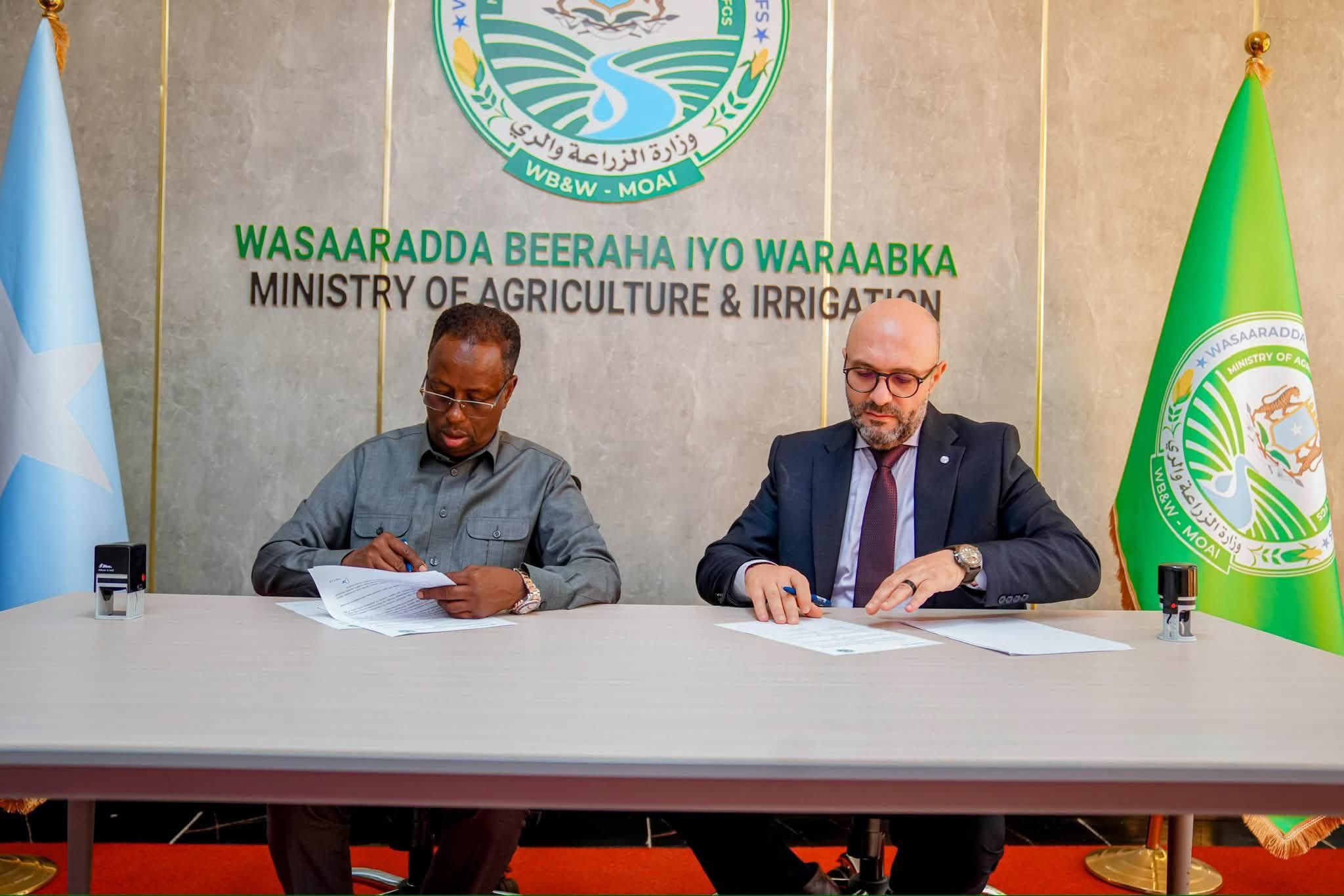
MOGADISHU, Somalia — Somalia’s Ministry of Agriculture and Irrigation has signed a memorandum of understanding with the United Nations Office for Project Services to expand cooperation on irrigation, agricultural infrastructure and flood prevention, part of a broader effort to strengthen the country’s food system.
Agriculture Minister Mohamed Abdi Hayir Maareeye met Ala’a Nemer, the UNOPS country director and representative in Somalia, at the ministry’s headquarters, where the agreement was signed.
The partnership is intended to support the ministry’s national mandate on food security and agricultural resource management, including implementation of Somalia’s National Transformation Plan and National Agriculture Transformation Strategy.
Much of the cooperation will focus on developing and rehabilitating irrigation infrastructure and protecting productive areas from flooding — priorities for a country where agriculture remains highly vulnerable to increasingly severe droughts and floods.
Somalia’s government has identified irrigation as a central part of its agricultural transformation agenda. Its national irrigation policy notes that recurrent drought and flooding have placed growing pressure on agricultural production and water resources.
The agreement also builds on existing cooperation between UNOPS and Somali institutions. In June, UNOPS joined the Somali government, the African Development Bank and the World Food Programme in an $11.8 million, three-year initiative aimed at strengthening climate-resilient agricultural and pastoral livelihoods in Hirshabelle and Puntland. The programme includes irrigation rehabilitation, sustainable land and water management, improved agricultural productivity and disaster preparedness.
For UNOPS, the emphasis is not only on constructing infrastructure but on creating systems that can withstand future climate shocks and remain useful to communities over time.
The latest agreement comes as Somalia seeks to shift from repeated emergency responses toward longer-term investment in food production and rural resilience. The country continues to face major food-security pressures, with drought, conflict and fragile livelihoods affecting millions of people.