
By Mohamed Dhugad
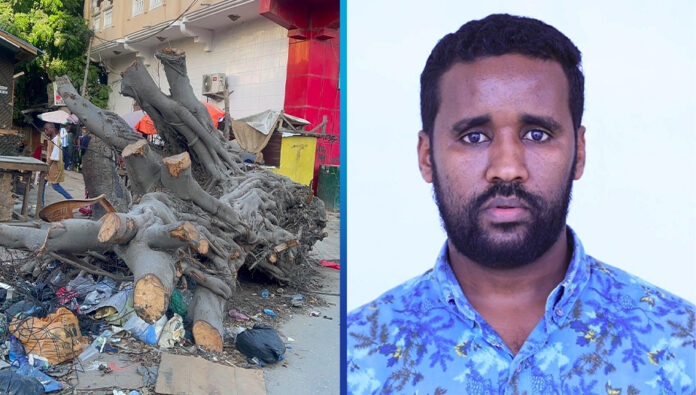
This week, as I drove through Via Liberia; Waaberi District in Mogadishu, I saw a heartbreaking scene. A giant shade tree, freshly cut, was lying lifeless on the street. Its massive trunk was cut into pieces and surrounded by piles of garbage. It had not fallen in a storm. It was cut down deliberately so a nearby shop could be more visible to passing customers.
This sight should trouble every resident of Mogadishu. A single tree may seem small, but its removal is a loss to the entire community. That tree cooled the street, filtered dust and air pollution, absorbed carbon dioxide, and gave pedestrians shade in the scorching sun. Its benefits were shared by thousands, but its destruction served only one.
There is a contradiction in our city governance. The Banadir Regional Authority (BRA) often requires residents to pay fees when they repair, paint, or improve their properties. These are constructive actions that make Mogadishu more livable. Yet in broad daylight, when a mature tree is cut down, an act with long-term environmental consequences, the municipality remains silent and inactive.
How can a government charge citizens for beautification, while ignoring those who destroy the natural guardians of our environment? This is unjust. It is reckless. It punishes improvement while tolerating destruction.
The Ministry of Environment and Climate Change, together with the municipality, must take responsibility. Unauthorized cutting of trees must be prohibited, fines and replanting required for offenders, and city trees recognized as protected public assets. Citizens must be reminded that a tree in the city is as vital as a water well in the village.
Without protection and enforcement, Mogadishu’s remaining trees will vanish, leaving the city hotter, dustier, and less livable.
The Waaberi tree should not be forgotten. It must be a wake-up call. Mogadishu needs an Urban Tree Protection By-Law that criminalizes unauthorized cutting and a City Greening Initiative that turns tax revenues into tree planting and care.
Other Somali cities already see the value of green. In Garowe, despite limited resources, campaigns to plant trees are underway because leaders there recognize the long-term benefits for public health and resilience. Mogadishu, by contrast, is failing to protect the trees it already has. Banadir should not take this for granted. What is destroyed today may one day be the very vision the city desperately tries to restore.
Mogadishu is a city working to rise from decades of hardship. Rebuilding is not only about walls, roads, and shops. It is also about the living green that makes a city human, healthy, and hopeful. If citizens are taxed for beautifying their neighborhoods, then those who destroy what belongs to us all must also be held accountable.
A city without trees is a city without shade, without breath, and without soul. Mogadishu deserves better.
About the Author
Mohamed Dhugad is a humanitarian and civic advocate with close to fifteen years of experience leading programs in crisis response, community resilience, and governance reform. He writes on issues of public accountability, social justice, and the future of Somalia’s democratic transformation.