

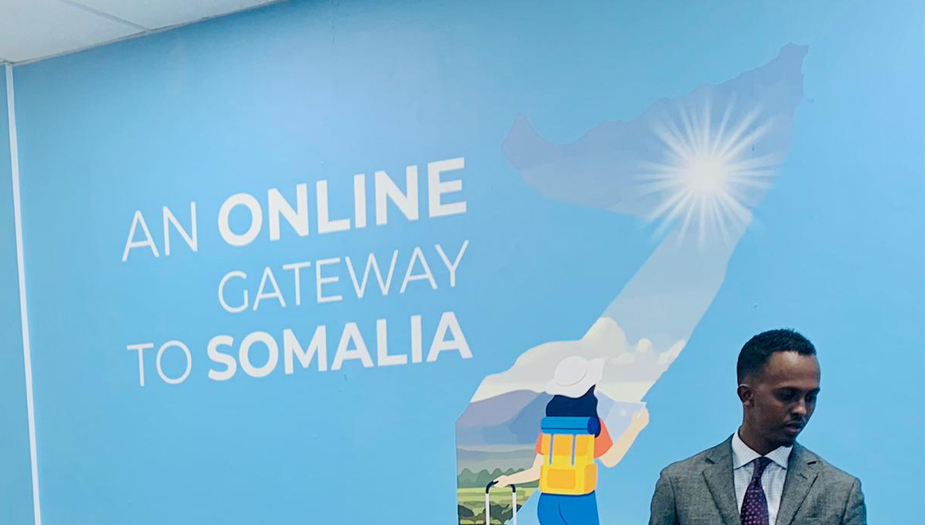
MOGADISHU, Somalia – For a country trying to convince the world that it has finally turned the corner, Somalia did not need this. A breach of its national E-Visa system — confirmed not by Mogadishu, but by the United States — has struck at the heart of the government’s most ambitious digital reform, and exposed deeper political fractures the country has long struggled to contain.
On November 11, 2025, hackers allegedly infiltrated Somalia’s E-Visa database and extracted the personal information of 35,000 applicants. Names. Photographs. Birth data. Contact details. Even diplomats. The U.S. Embassy in Mogadishu broke the silence days later, saying media reports were “credible” and warning that anyone who used the system may have had their data compromised.
The Somali government’s response so far has been striking in its absence. No televised address. No technical report. No statement acknowledging the scope of the breach. In a region where political communication is already thin, the vacuum is loud.
Washington’s unusually direct confirmation has forced a reckoning that cannot be deferred. The stakes are high: Somalia has spent years rebuilding international trust, modernizing its airports, and promoting a narrative of stability. But cybersecurity is unforgiving. A single breach can unravel years of diplomatic confidence and leave thousands vulnerable to identity theft, blackmail, or exploitation.
At home, criticism emerged first from Puntland, not Mogadishu. Abdifatah Abdinuur, the region’s minister for the presidency, went on record saying the American concerns should be “a wake-up call,” and that the current system exposes citizens to real and rising dangers. He did not frame the issue as a political jab, but as a structural failure — a reminder that modern governance cannot survive without digital security at its core.
Yet the E-Visa breach has collided with another storm already brewing: the escalating dispute between Somalia and Somaliland over sovereignty, borders, and who controls the skies above the Horn of Africa.
In Hargeisa, officials seized the moment to underscore their long-held position. Mohamed Abdirahman, Director General at Somaliland’s Foreign Ministry, issued a sweeping declaration: only visas issued by Somaliland are valid for entry into its territory. Visas issued by the Federal Government of Somalia, he said, are “invalid and will not be recognized under any circumstances.”
The statement was more than a legal argument. It was a political line in the sand — reinforced by Somaliland’s claim that, as of November 10, it has fully reclaimed authority over its own airspace. Airlines flying through Somaliland are now told to seek clearance from the Hargeisa Control Tower. Mogadishu’s attempt to impose its E-Visa requirement on Somaliland dual nationals touched a nerve, igniting public frustration and pushing an already tense relationship into a new and uncertain phase.
For observers in the region, the timing could not be worse. A cyberattack that should have prompted a unified national response has instead exposed how deeply Somalia’s internal disagreements remain intertwined with its international posture. The E-Visa breach is not just a technological failure; it has become a symbol of competing political narratives — one federal, one separatist, and both increasingly incompatible.
Lost amid the tension is the voice of the man running the E-Visa program itself. Ashkir Cabdi Ashkir, the system’s director and one of its most vocal defenders, speaks with the urgency of someone who believes Somalia cannot afford to abandon modernization.
In an interview with Arlaadi Media Network, he insisted the platform is a leap forward in security and global credibility. He described a round-the-clock operation staffed by dedicated professionals. His message to Somalis — especially those with dual nationality — was both patriotic and pleading: the country’s image depends on embracing systems that bring it in line with international standards.
It is an argument that resonates in many capitals. Digital reform is not optional for a nation hoping to integrate into global commerce and travel. Yet ambition alone cannot secure a database, nor can good intentions reverse a breach already in the wild.
Somalia now faces two urgent tests. The first is technical: identifying the scale of the hack, securing the compromised infrastructure, and rebuilding confidence among citizens and foreign travelers alike. The second is political: whether the federal government can address a national crisis without allowing it to deepen the existing divides between Mogadishu and Hargeisa.
Silence will not offer protection, nor will it bring clarity. Governments earn trust not by avoiding hard truths but by confronting them. The longer the federal authorities wait to give a transparent account of what happened, the wider the credibility gap becomes.
For years, Somalia has fought to reclaim control of its narrative — from conflict to recovery, from isolation to engagement, from instability to progress. The E-Visa breach does not erase that progress, but it forces a new question: can the institutions charged with safeguarding the future withstand the pressures of the present?
This is more than a cybersecurity incident. It is a moment of national introspection. And the world — allies, critics, neighbors — is watching closely to see which Somalia responds: the one committed to the hard work of rebuilding, or the one still struggling to speak with a single, confident voice.


