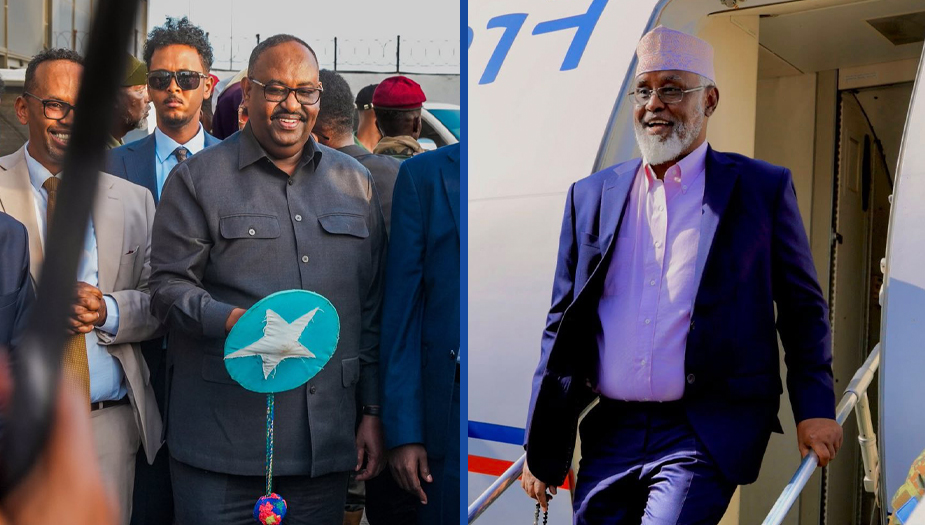
MOGADISHU, Somalia — The presidents of Puntland and Jubaland, Said Abdullahi Deni and Ahmed Mohamed Islam (Ahmed Madobe), arrived in Somalia’s capital on Tuesday, signaling a potentially pivotal moment in the country’s fragile political process ahead of the 2026 elections.
Their arrival comes as Somalia faces deepening divisions between the federal government and regional administrations over constitutional reforms and the structure of the upcoming elections, issues that have exposed fault lines within the federal system and raised concerns about political stability.
A return shaped by past confrontations
For Ahmed Madobe, the visit marks his first return to Mogadishu since October 2024, when he withdrew from the National Consultative Council meeting after a dispute with the federal government over election arrangements.
Despite opposition from Villa Somalia, Madobe went on to organize regional elections in November 2024, intensifying political and security tensions between Jubaland and the federal government.
Said Abdullahi Deni, meanwhile, has not visited Mogadishu since November 2022, months after the May 2022 presidential election in which he was a leading contender. His political rivalry with President Hassan Sheikh Mohamud has played out across both political and security arenas, reflecting broader struggles over power-sharing and federal authority.
Core issues at the negotiating table
At the center of the talks are two highly sensitive issues:proposed amendments to Somalia’s provisional constitution and the model and roadmap for the 2026 national elections
Observers say the negotiations are unlikely to yield immediate breakthroughs and may require multiple rounds of dialogue.
However, time pressure is mounting, with the parliamentary term set to expire on April 14, 2026, and President Hassan Sheikh Mohamud’s mandate ending on May 15, 2026.
Analysts warn that failure to reach consensus before those deadlines could trigger a constitutional crisis and undermine Somalia’s political transition.
Pressure on the federal government
The presence of Deni and Madobe in Mogadishu is also reshaping the political landscape in the capital. Analysts say it increases pressure on Prime Minister Hamza Abdi Barre, whose political influence could be tested by the renewed alignment of regional leaders and opposition figures.
Some political observers believe the negotiations could ultimately lead to a broader political settlement, potentially including changes to the composition of the federal government to ensure a more inclusive electoral process.
Supporters of the federal government, however, argue that the opposition is seeking to derail the government’s reform agenda and that the existing roadmap should remain intact.
Security tensions and mistrust
The talks are taking place amid lingering mistrust between Mogadishu and regional states. In recent weeks, Puntland and Jubaland accused the federal government of obstructing security delegations and restricting the movement of their officials, underscoring the fragile nature of the negotiations.
Despite these tensions, technical teams from the government and opposition have begun preliminary discussions on electoral arrangements, suggesting cautious progress toward dialogue.
Diplomatic sources say the international community, which played a key role in facilitating the talks scheduled between February 10 and February 12, 2026, is closely monitoring how Somali leaders navigate disagreements over the election framework and whether any agreements reached can be implemented.
A decisive moment for Somalia
International observers warn that Somalia’s political future will depend not only on reaching a deal but also on building trust among key stakeholders in a system long shaped by conflict and competing power centers.
The arrival of the Puntland and Jubaland leaders injects new momentum into Somalia’s opposition politics and could redefine the balance of power in Mogadishu.
Nevertheless, as Somalia moves closer to the 2026 elections, the coming days of negotiations may prove decisive in determining whether the country’s political elite can avoid another cycle of political confrontation — or move toward a more stable and inclusive political settlement.