
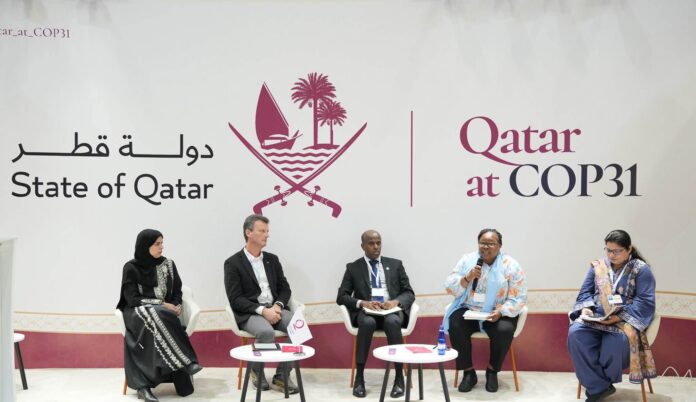
ANTALYA, Türkiye — Qatar Charity has highlighted the growing humanitarian challenges facing climate-vulnerable communities in Somalia during an international discussion on climate change and humanitarian response held on the sidelines of the COP31 climate conference in Antalya, Türkiye.
Abdelfattah Adam, head of Qatar Charity’s Somalia office, participated in the forum, organised by Qatar Charity in cooperation with Qatar’s Ministry of Environment and Climate Change.
The discussion focused on the need to rethink responses to climate-related humanitarian crises, including floods and heatwaves, by moving beyond emergency relief towards long-term strategies that strengthen community resilience and protect livelihoods.
Speaking at the event, Adam shared the experience of Qatar Charity’s operations in Somalia, drawing attention to the difficulties faced by vulnerable communities whose livelihoods depend heavily on agriculture, livestock and natural resources.
He highlighted the importance of expanding support for communities affected by recurring droughts, floods and other climate-related emergencies, enabling them to adapt to changing environmental conditions and recover from their effects.
The discussion was moderated by Aisha Al-Kuwari, Qatar Charity’s director of humanitarian operations. Other participants included Christophe Belperron, senior climate change adviser at Save the Children International; Daisy Mukarakate, UNDP climate policy adviser for Africa; and Sumera Javeed, communications and donor relations adviser at Pakistan’s HANDS Welfare Foundation.
The participants exchanged expertise and perspectives on strengthening responses to climate-related humanitarian challenges, particularly in countries and communities facing heightened environmental vulnerability.
Somalia is particularly exposed to climate shocks, with droughts and floods repeatedly affecting rural livelihoods, food security and displacement. Communities dependent on livestock and rain-fed agriculture are especially vulnerable when prolonged dry periods or heavy rainfall disrupt their sources of income and food.
The forum underscored the importance of linking humanitarian assistance with climate adaptation and sustainable development, rather than treating emergency relief and long-term resilience as separate priorities.
Qatar Charity said its work increasingly focuses on connecting humanitarian assistance with climate action and sustainable solutions, including protecting livelihoods and helping vulnerable communities better withstand environmental and humanitarian challenges.
The organisation’s participation at COP31 provided an opportunity to share its experience in Somalia and exchange approaches with international humanitarian and climate specialists.