
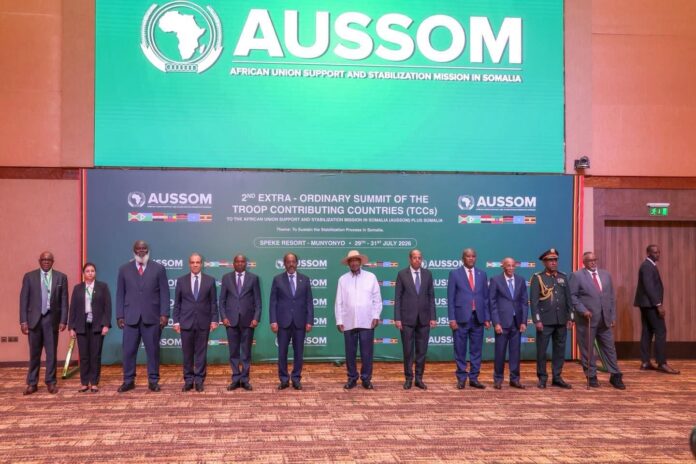
KAMPALA, Uganda — African leaders contributing troops to the African Union Support and Stabilization Mission in Somalia (AUSSOM) agreed on Friday to support a gradual, conditions-based transition of the mission, warning that Somalia’s security gains could be at risk without sustained international funding and closer cooperation between Mogadishu and regional partners.
Meeting in Kampala alongside Somali President Hassan Sheikh Mohamud, leaders from Uganda, Kenya, Burundi, Djibouti, Ethiopia and Egypt endorsed a strategy that would keep international logistical support in place for 18 to 24 months while Somali security forces continue building the capacity needed to assume full responsibility for national security.
The summit comes at a critical moment for AUSSOM, which replaced the African Union Transition Mission in Somalia (ATMIS) in 2025 with a mandate focused on supporting Somali forces while gradually handing over security responsibilities. The mission has faced growing financial uncertainty after key international partners questioned future funding arrangements, raising concerns that a sudden reduction in support could undermine operations against Al-Shabaab.
In a joint communiqué issued after the meeting, participating governments stressed the need for an orderly and coordinated drawdown rather than a rapid withdrawal, saying uninterrupted logistical support authorized by the United Nations Security Council would be essential to achieving agreed security benchmarks and preventing militants from exploiting any security vacuum.
The leaders instructed military chiefs to accelerate plans to defeat Al-Shabaab, including expanding community and local defense forces to hold territory recaptured from the militant group. They also called for increased air power, intelligence, surveillance and reconnaissance capabilities, arguing that additional force multipliers are necessary to sustain military pressure on the insurgency.
The communiqué urged the Somali government to strengthen cooperation with federal member states and traditional elders, describing broader political engagement as an important element of the country’s counterinsurgency strategy. It also emphasized the need to continue building a professional national army capable of eventually assuming full responsibility for Somalia’s security.
Recognizing the mission’s financial challenges, the summit tasked the foreign ministers of troop-contributing countries, working with Somalia and the African Union, to establish a joint diplomatic task force to seek predictable and sustainable financing for AUSSOM. The group will also organize a donor conference aimed at securing additional political and financial support during the transition period.
The leaders agreed to forward the summit’s recommendations to the African Union Peace and Security Council for endorsement before they are transmitted to the United Nations Security Council.
For nearly two decades, African Union peacekeepers have played a central role in helping Somalia reclaim territory from Al-Shabaab, train national security forces and protect key government institutions. Despite those gains, the Islamist group continues to carry out deadly attacks across Somalia, underscoring the challenge of balancing a gradual security transition with the need to maintain military pressure on one of East Africa’s most resilient insurgencies.