

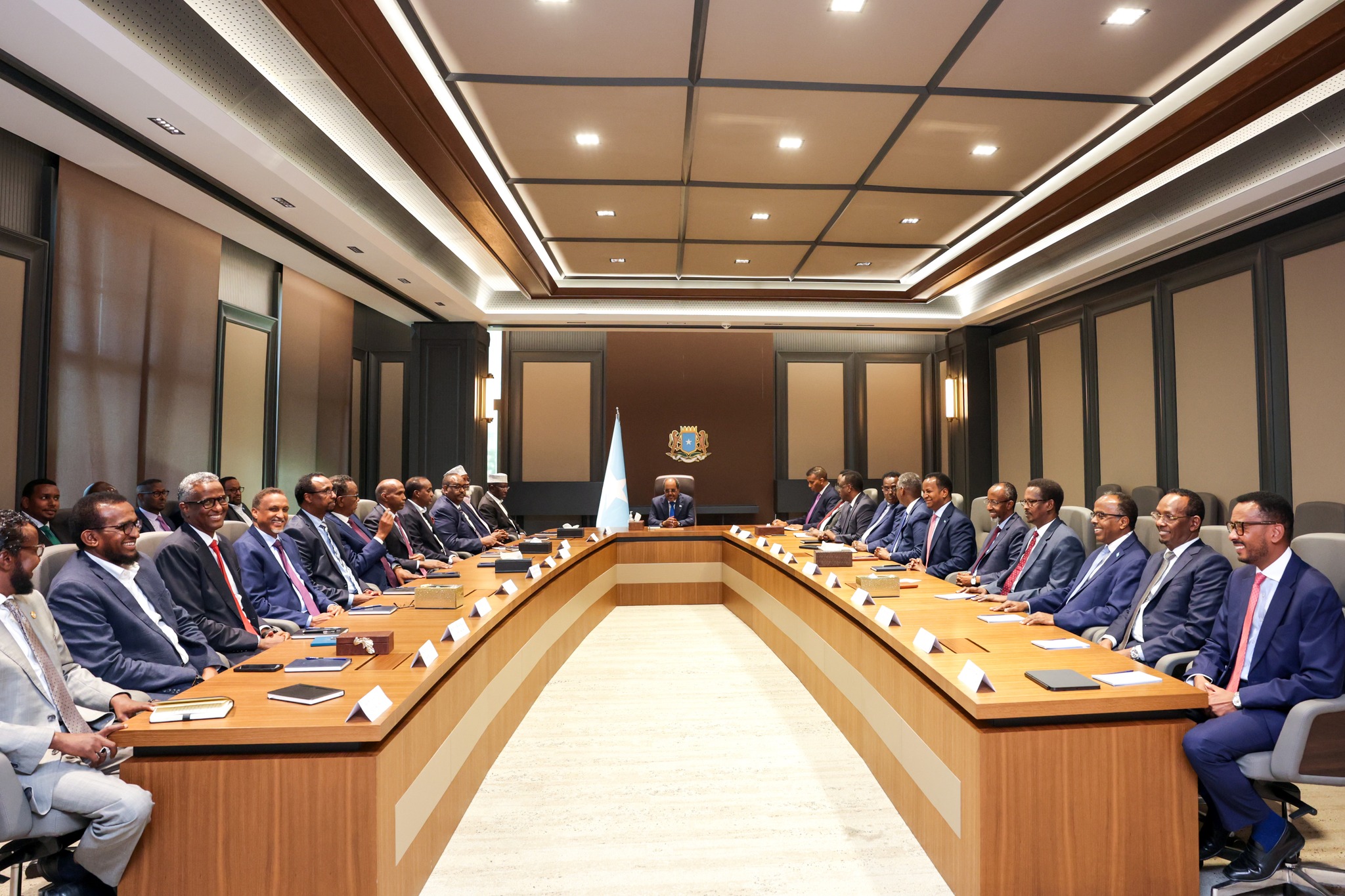
MOGADISHU, Somalia – Somalia’s fragile political order has been jolted by a dramatic collapse of negotiations between President Hassan Sheikh Mohamud’s administration and the opposition-aligned Somali Future Council — an implosion that has laid bare the country’s deepening constitutional fault lines and ignited a fierce war of words between Mogadishu and key federal states.
What was billed as a decisive round of talks on constitutional amendments and the framework for the 2026 elections has instead unraveled into a bitter standoff — one that now threatens to metastasize into a full-blown institutional crisis.
The Walkout: “Bulldozing” vs. “Bad Faith”
The Somali Future Council — a coalition that includes leaders aligned with Puntland State House and Jubaland State House — announced that talks had “collapsed without a breakthrough,” accusing Villa Somalia of pressing ahead with controversial constitutional changes while the country grapples with drought, insecurity, and economic strain.
In a blistering statement, the bloc alleged that the federal government was “sidelining dozens of lawmakers, intimidating opponents, and plotting elections under disputed new rules” designed to tighten its grip on power.
The language was unmistakably confrontational. The opposition warned it would not stand idle as Somalia “edges toward a constitutional crisis and further chaos.” The federal government swiftly pushed back.
In its own statement, Mogadishu insisted it had engaged in continuous consultations with former leaders, civil society, and political actors since launching a national dialogue initiative in March 2025.
A Sudden Departure, A Stark Signal
Officials said formal talks, which opened at the presidential palace on Feb. 18, 2026, faltered only after opposition representatives introduced what the government described as new agenda items lacking constitutional basis. Negotiations, the government stressed, remain open—provided they proceed “in accordance with the law.”
The political drama intensified when Ahmed Mohamed Islam — a central figure within the Future Council — departed Mogadishu in what sources described as a “sudden move.”
The optics were unmistakable: a regional president leaving the capital at the precise moment constitutional negotiations collapsed.
For many observers, the departure signaled not merely tactical frustration but a widening gulf between federal authorities and influential member states. Somalia’s federal system, long strained by disputes over power-sharing and electoral modalities, now appears to be entering a new phase of open confrontation.
Power, Process, and the 2026 Elections
At the heart of the impasse lies the unfinished provisional constitution and the mechanics of the 2026 polls.
President Hassan Sheikh Mohamud has framed constitutional completion and electoral reform as historic imperatives—steps toward universal suffrage and a more centralized, coherent state. His allies argue that Somalia cannot remain trapped in an indirect, clan-mediated electoral model if it hopes to modernize governance and attract sustained international investment.
The opposition sees it differently. Critics argue that rushing constitutional amendments without broad consensus risks hollowing out federalism. They fear a recalibration of powers that would tilt the balance decisively toward Mogadishu, weakening regional autonomy and consolidating executive authority at the center.
The dispute is not merely procedural—it is existential. It goes to the core of how Somalia defines sovereignty, representation, and the distribution of power between the center and its federal member states.
International Alarm Bells
Somalia’s partners are watching with growing unease. The British Embassy Mogadishu welcomed the talks but expressed disappointment at the absence of consensus, urging compromise and sustained dialogue.
The United States’ Embassy in Mogadishu issued a firm appeal, warning that only a united political front can effectively counter terrorism and protect Somalia’s fragile gains.
Regional bloc Intergovernmental Authority on Development weighed in as well. Executive Secretary Workneh Gebeyehucalled for negotiations in “good faith,” reaffirming solidarity with Somalia’s citizens as tensions mount.
Behind the diplomatic phrasing lies a clear anxiety: Somalia’s security architecture —already stretched by the insurgency of al-Shabab — cannot withstand prolonged elite fragmentation.
Political Paralysis and the Risk of State Failure
Experts warn that the fallout from the walkout could be catastrophic. “If this trajectory continues, it risks leaving the country without a government that has a mandate or political direction,” said Afyare Elmi, a political researcher.
Political paralysis amid ongoing humanitarian crises — including drought, displacement, and economic instability — could erode the legitimacy of both the federal government and member states, leaving Somalia vulnerable to internal and external shocks.
Elmi underscores that the collapse is not simply procedural: “Since its unilateral decision to create a new constitution in 2024, the real intention of Villa Somalia has been a power grab disguised as ‘one person, one vote.’ The government aimed to set election rules, appoint commissioners, and oversee the process simultaneously. This plan has not succeeded—and the country is paying the price.”
The expert warns that continued obstructionism may deepen polarization, weaken institutions, and stall urgently needed reforms. Without decisive action, Somalia risks sliding into a governance vacuum just as international partners intensify pressure and the 2026 electoral timeline approaches.
Rebuilding Trust or Sliding into Crisis
Despite the stalemate, Elmi emphasizes that solutions remain possible: “Before it is too late, President Hassan Sheikh Mohamud must revert to the agreed political settlement, ensure consensus on the 2026 transition, and secure that implementation begins before May 2026.”
Analysts argue that restoring trust between Mogadishu and the federal member states, respecting agreed security protocols, and engaging civil society meaningfully are critical to averting a constitutional and humanitarian catastrophe.
International actors — including the UK, US, and IGAD — have signaled readiness to support a neutral facilitation process. However, the effectiveness of external intervention depends on genuine political will from Somali leaders, particularly in respecting prior agreements and avoiding unilateral maneuvers.
Ultimately, Somalia’s political elite faces a stark choice: cooperate to stabilize governance and protect the nation, or continue a cycle of brinkmanship that threatens the country’s democratic trajectory and the security of its citizens. The coming weeks will determine whether Somalia moves toward constructive constitutional reform or spirals further into uncertainty and chaos.


