
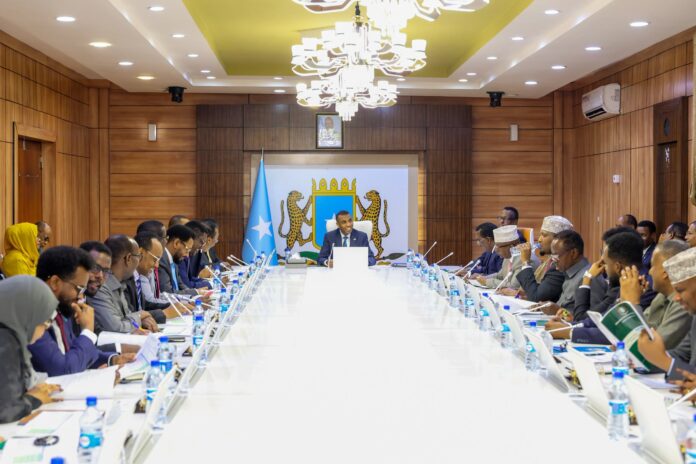
MOGADISHU, Somalia — Somalia’s economy grew by 3.1% in 2025, according to a report presented to the cabinet, as the government advances domestic tax collection and financial reforms aimed at reducing reliance on external assistance.
The latest national accounts estimate, published by Somalia’s National Bureau of Statistics, puts real gross domestic product growth at 3.1% in 2025, down from 4.0% in 2024. Economic activity was supported by household consumption, government spending and investment.
Prime Minister Hamza Abdi Barre has described greater economic self-reliance as a central government objective, alongside efforts to strengthen state institutions and expand domestic sources of revenue.
The government has been pursuing a broader fiscal reform programme, including changes to income taxation, customs administration and the collection of non-tax revenues. The International Monetary Fund has said Somalia aims to raise domestic revenues sufficiently to cover operational expenditure by 2027.
Somalia’s new income tax law, signed in May 2025, forms part of those efforts, while customs reforms include the rollout of the Somalia Customs Automated System and measures to improve tax compliance and revenue administration.
The economic figures come as the government implements its National Transformation Plan for 2025-2029, a five-year strategy focused on governance, economic diversification, infrastructure, human development and climate resilience. The plan aims to put Somalia on a path toward becoming a more stable and economically self-sustaining country.
Security gains
The cabinet also received a separate briefing on recent military operations against Al-Shabaab, with officials reporting gains by Somali national forces.
The security campaign remains closely linked to the government’s broader state-building agenda, as authorities seek to expand government control, improve security and create conditions for economic activity.
The government has increasingly emphasized the connection between improved security and economic development, arguing that stronger domestic institutions and greater control over national resources are necessary to reduce dependence on foreign assistance.
Somalia’s economic growth remains modest, however, and the government faces significant challenges, including limited domestic revenue, infrastructure gaps, a large informal economy and continued security pressures.
The 3.1% expansion nevertheless provides a measure of economic momentum as Mogadishu seeks to turn recent fiscal and institutional reforms into longer-term growth and greater financial independence.