
KISMAYO, Jubaland – A broad coalition of Somalia’s opposition leaders has accused President Hassan Sheikh Mohamud of constitutional violations, governance failures and abandoning the fight against the militant group Al-Shabaab, warning that the country risks political collapse, worsening insecurity and economic breakdown if an inclusive political settlement is not reached.
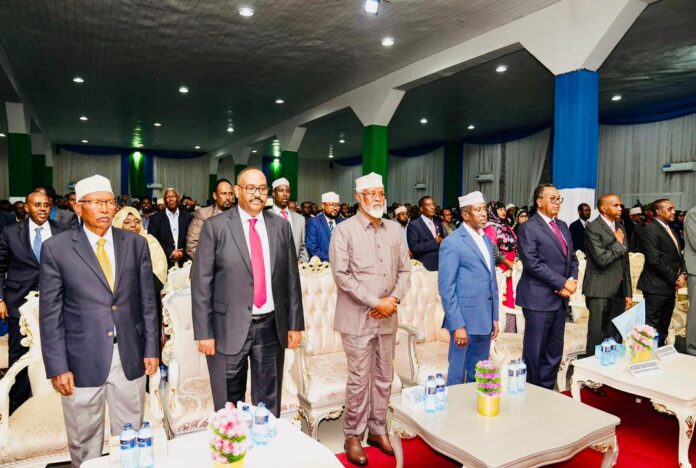
The accusations were laid out in a strongly worded communiqué issued at the end of a three-day National Consultation Conference held in the southern port city of Kismayo. The meeting brought together an influential mix of federal member state leaders, former national leaders and sitting lawmakers, underscoring the depth of opposition to the president’s current political course.
Among those represented were the presidents of Puntland and Jubaland states, Said Abdullahi Deni and Ahmed Mohamed Islam (Madobe), former President Sharif Sheikh Ahmed, former prime ministers Abdi Farah Shirdon, Hassan Ali Khaire and Mohamed Hussein Roble, as well as members of parliament and declared presidential candidates.
Rejection of term extensions
At the heart of the dispute is the electoral timeline. The opposition categorically rejected any extension of government mandates beyond the constitutional deadlines of 14 April 2026 for parliament and 15 May 2026 for the presidency, warning that any delay would create a constitutional vacuum.
“The 2012 Provisional Constitution remains the sole legal foundation of Somalia’s state-building,” the communiqué said, declaring all unilateral constitutional amendments introduced under President Mohamud “null and void.”
The group called for national elections to be held on time, through consensus among political stakeholders, and overseen by an electoral commission agreed upon by all sides. They argued that future elections must be more credible than the 2022 polls and better reflect constituency-based representation.
One-month deadline
In an ultimatum to the president, the opposition gave Mohamud one month — until 20 January 2026 — to convene all political stakeholders and reach agreement on an inclusive and timely electoral process.
If no progress is made, the group warned it would pursue “alternative arrangements” to prevent what it described as an impending political and security breakdown. The communiqué explicitly raised the possibility of a parallel electoral process if constructive dialogue does not begin within that timeframe.
The opposition also rejected the ongoing Banadir (Mogadishu) election process, calling it unconstitutional and illegitimate due to the unresolved legal status of the capital. In addition, they urged federal member state leaders whose mandates have expired to organize their own elections in line with their respective constitutions and electoral laws.
President responds cautiously
President Mohamud, speaking earlier at a separate commemoration event, downplayed the significance of the Kismayo meeting but left the door open to talks. “If the opposition presents a unified position, we are happy to discuss with them,” he said.
The president has previously defended his reform agenda as necessary to move Somalia toward a more direct, one-person-one-vote electoral system, arguing that delays and political disagreements have long hindered state-building efforts.
Former President Mohamed Abdullahi Mohamed, known as Farmaajo, did not attend the Kismayo conference. However, sources close to him say he broadly agrees with the positions outlined in the communiqué, further highlighting the breadth of concern among Somalia’s political elite.
International Community Stakes
The opposition appealed to the international community — a key financial and security backer of Somalia — to support efforts toward inclusive elections and to press all sides to avoid a return to political fragmentation.
With President Mohamud’s mandate set to expire in less than five months, the standoff raises fresh uncertainty for a country still battling Al-Shabaab, grappling with humanitarian challenges and seeking to consolidate fragile federal institutions. Whether dialogue can bridge the widening political divide may determine Somalia’s stability in the critical period ahead.