
MOGADISHU, Somalia – In Bosaso and Mogadishu, where displacement sites sit alongside rapidly evolving urban communities, Somalia’s development story is increasingly defined by one question: how to turn long-term humanitarian dependence into sustainable recovery.
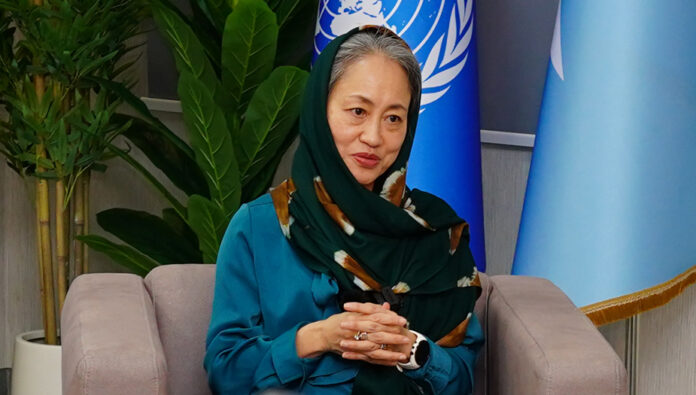
That question framed a recent conversation with UN Assistant Secretary-General and UNDP Crisis Bureau Director Shoko Noda, following her May 3–6 visit to Somalia. Speaking with Arlaadi Media Director-General Abdirahman Jaylani Mohamed, she reflected on what she saw in displacement camps, youth training centers, and government discussions across the country.
Her message centered on a shift already underway—but still incomplete: from fragmented humanitarian responses toward integrated national systems that prioritize durable solutions, empower local authorities, and unlock the energy of Somalia’s young population.
Q: Many displaced families in Somalia spend years in camps without access to permanent housing or stable livelihoods. In your view, what is the biggest obstacle to achieving durable solutions for IDPs, and how can that gap be closed? Particularly through a stronger Humanitarian–Development–Peace Nexus approach?
A: In Somalia and everywhere I visit, I try to meet people who are displaced and see whether our support is having an impact. They say they want to be out of those camps, that temporary arrangement often feels permanent, and they don’t see a future.
What displaced communities need is development support to help them become more self-reliant. They need options – integrating locally, moving to another place, or going back to their original homes. In most cases, those who are displaced would like to be integrated locally. In such scenarios, host communities need support too, because their resources and services are now shared.
Any community hosting displaced people is generous. But for that, we need a holistic development approach: for the people living in the camps, for the host communities, as well as for local and national governments. Local governments also need more capacity to be able to provide critical services, so we need to focus this aspect too.
The Somali government has a national transformation plan, which includes forced displacement as a priority. That’s an important step. The Ministry of Finance is now finalizing the integrated national finance framework that also has a component for internal displacement. All such policies and actions now need to be linked.
Q: At a time when funding is shrinking globally, how can Somalia protect the progress made so far while maintaining effective crisis response? How is UNDP helping address this?
A: Yes, the global scenario is evolving, and funding is definitely shrinking. Will it go back to the previous level or not? We don’t know for sure. What is important here is to adapt and make the best use of the resources available. We need strong national leadership and political determination to do that – whether it is humanitarian assistance or development assistance – the government and Somali people need to lead it instead of being more dependent on external factors and external support.
The aid system also needs to be also readjusted to make sure that there is space for national and local governments to lead that work. We should not be developing parallel structures, often often we see that with humanitarian support in countries, probably including Somalia as well. Ultimately, national leadership is extremely important.
We also need to engage the private sector much more from the beginning because the role of official development assistance (ODA) in economic growth is very limited. I always cite my own country, Japan’s example after World War II. Yes, we had some support, but then it was the Japanese who really had determination to go back to where we were which led to economic growth. So, that kind of national drive is very, very important, and engaging the private sector is the key for sustained economic growth.
Q: Drawing on your recent engagements with Somali counterparts, how do you assess Somalia’s progress in transitioning from repeated crisis response to sustainable, nationally led peacebuilding and resilience systems, and where do you see the most critical gaps remaining?
A: The government and the Somali people themselves need to demand development solutions, not only humanitarian solutions, and really be in the driving seat to lead the growth of their own country.
It’s in UNDP’s DNA to really listen to what is needed. We always have discussions, listen and co-create solutions. I think Somalia needs your own localised solutions, and this is where I am confident that UNDP can come in and really continue to work with you.
Q: How does UNDP ensure that its programs effectively create inclusive and sustainable employment opportunities, particularly for women and youth?
A: I visited the Elman Peace Centre in Mogadishu and was very encouraged to see young people who are now learning practical skills to go to the job market and then be financially independent, and thus in their own way contribute to the country’s growth. There were both girls and boys learning how to repair mobile phones.
I met Fartun who was about to graduate from that course and had a dream to start a mobile repair shop with some of the other students. That gave me a sense of hope that Somali youth – who are 75% of the country’s population – have an aspiration to really create their own employment rather than waiting for jobs.
There were others who were learning mechanical repairs, who were learning plumbing, and these are young people who have gone through a very difficult time in the past. UNDP is not supporting them directly, but we are doing it through this Elman Peace Centre, which is a local organization. As much as possible, we should find capable local partners to run such a programmes with support from our side.
Q: Building trust between communities, authorities, and partners is often a challenge. So is building social cohesion among communities. What helps build that trust, while also creating economic opportunities for the Somali youth? And where do you see progress?
A: I have been in discussions with various ministries and civil society actors. It was encouraging to see the different perspectives emerging. I also saw how passionate civil society organizations like Elman Peace Centre and Somali Survivors are to create a real impact during my interaction with them.
I also had a positive experience during my field visit to Bosaso to see the durable solutions for internally displaced persons (IDPs). Building trust between communities, authorities, and partners requires sustained engagement, inclusive governance, and visible peace dividends.
In Somalia, trust is strengthened when communities see that institutions are responsive to their needs, that local voices are included in decision-making, and that improvements in security are accompanied by tangible gains in livelihoods, justice, service delivery, and social inclusion. Social cohesion is particularly reinforced when women, youth, religious leaders, elders, civil society, and local authorities are engaged together in nationally-led and community-driven processes.
During the roundtable conference on peacebuilding architecture at the exit of UNTMIS, which I joined in Mogadishu, one strong point emerged as I interacted with and senior government officials from several ministries – that economic opportunity for Somali youth is central to sustaining peace and stability. UNDP’s experience demonstrates that investments in skill development, livelihoods, entrepreneurship, local economic recovery, and community-based reintegration contribute not only to employment generation but also to resilience and social cohesion.
We are seeing encouraging progress in areas where stabilization efforts are linked with local governance, youth engagement, reconciliation, and economic recovery initiatives. Increasingly, there is recognition among national stakeholders that peacebuilding and development must advance together, particularly in the context of Somalia’s ongoing transition.
Q: What message would you like to share with the people of Somalia?
A: I was really impressed with the progress that the country has made over the past two to three decades. I think there were some ups and downs, and still I think there are some challenges ahead, but overall, I think Somalia should be proud of the progress that has been made.
I think young people’s engagement is the key for a bright future. Having met them, I remain hopeful that Somalia is on the right track for a brighter future.