
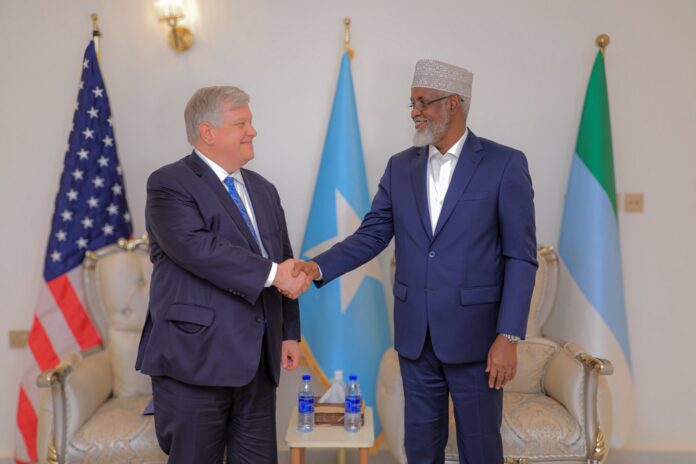
KISMAYO, Somalia — Jubaland’s regional interim capital became a hub of diplomatic activity on Monday as President Ahmed Mohamed Islam “Madobe” welcomed U.S. Ambassador to Somalia Richard Riley and a high-ranking American delegation for what officials described as “comprehensive strategic talks”.
A statement from Madobe’s office said the discussions delved into expanding joint security operations, bolstering U.S.-funded development projects, and evaluating Somalia’s political direction as it works toward strengthening state institutions.
The U.S. Embassy in Mogadishu echoed the focus on cooperation, noting that Ambassador Riley underscored the need for Somali leaders to close ranks in the fight against terrorism.
“Today, Jubaland President Madobe and I met in Kismayo to discuss the importance of national unity to fight terrorism for the benefit of the people of Jubaland and all of Somalia,” Ambassador Riley said.
The timing of the visit is notable. Somalia is juggling heightened security demands while simultaneously pushing through significant governance reforms.
At the same time, political temperatures are rising: opposition leaders are preparing to convene a major conference in Kismayo, placing the city at the heart of a national debate over the 2026 electoral system.
The federal government is advocating for the country’s first direct universal suffrage, while opposition figures insist that Somalia should retain its indirect, clan-based electoral model, arguing that conditions are not yet suitable for a nationwide popular vote.
This standoff—compounded by controversial constitutional amendments advanced by the government—has deepened divisions and raised fears of a broader political rupture.
Nevertheless, against this backdrop, the United States delegation’s presence in the coastal city Kismayo apparently serves as a reminder of Washington’s stake in Somalia’s stability and its continued engagement as the Horn of Africa country navigates one of its most sensitive security and political transitions in years.